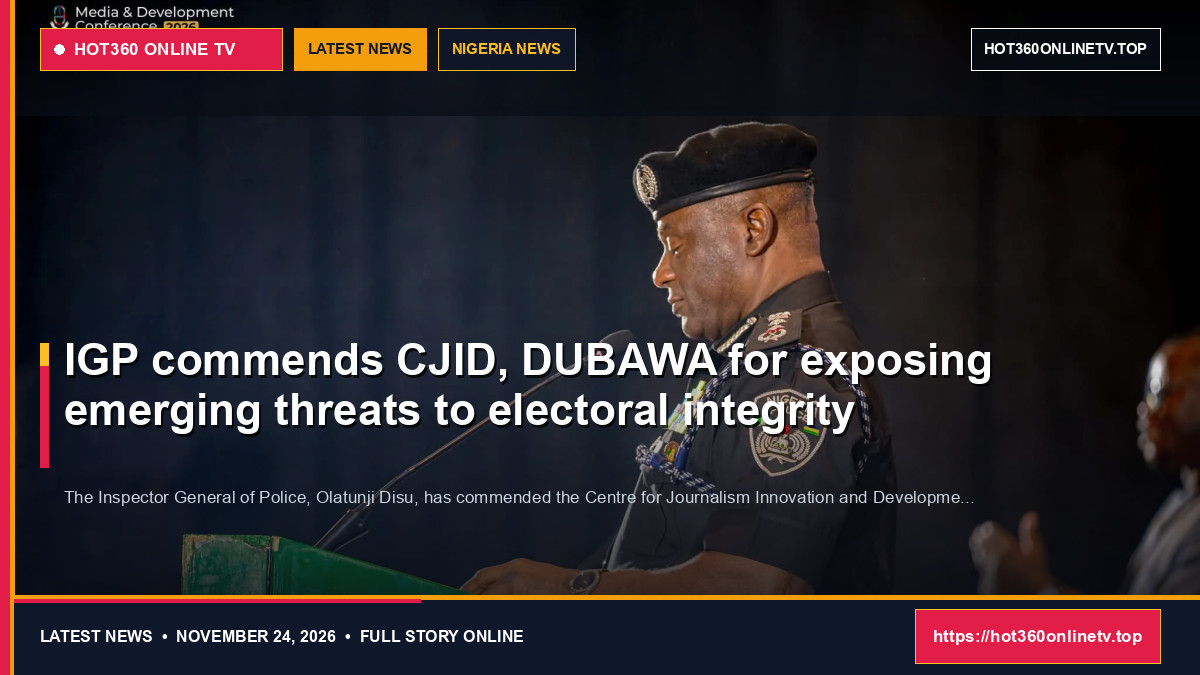
The Inspector General of Police, Olatunji Disu, has commended the Centre for Journalism Innovation and Development (CJID) and its fact-checking initiative, DUBAWA, for their investigations and monitoring of emerging threats to media and electoral integrity ahead of the 2027 general elections.
Join the Premium Times WhatsApp Community For Quick Access To News and Happenings Around You.
Mr Disu gave the commendation in his keynote address at the Media and Development Conference (MDC), organised by CJID, where he praised the organisations for their work on foreign information manipulation and interference (FIMI), AI-generated disinformation and coordinated disinformation campaigns.
PREMIUM TIMES reports that CJID and DUBAWA have undertaken several initiatives to investigate and counter misinformation, disinformation and emerging threats to democracy and information integrity, including election observation, collaborative fact-checking, research into electoral disinformation and investigations into foreign influence operations.
In a November 2024 investigation, DUBAWA examined how a Telegram channel, identified as “Africa Initiative”, used influencers and social media platforms, including TikTok, to amplify pro-Russian narratives during Nigeria’s #EndBadGovernance protests.
The investigation traced how influencers were supplied with talking points and encouraged to promote messages calling for Russian intervention and military rule.
In another investigation, DUBAWA examined coordinated accounts on X allegedly driving pro-Russian propaganda and anti-democratic narratives in Nigeria, highlighting the use of coordinated online activity to influence public discourse.
Ahead of the 2027 elections, DUBAWA has also expanded its media literacy efforts, including training electoral stakeholders on misinformation and fact-checking and partnering with TikTok to provide educational content to help users identify misleading and AI-generated content.
Stay Ahead with Premium Times
Follow us on Google News and never miss breaking stories, investigations, and in-depth reporting.
Mr Disu said the organisations’ findings highlighted growing threats capable of distorting political participation, eroding public trust and undermining democratic institutions.
“Your findings are not abstract. They speak to a real danger: that lies, when left unchecked, can distort political participation, weaken public trust, and undermine democratic institutions,” he said.
The IGP said election security was a collective responsibility requiring the involvement of the police, the Independent National Electoral Commission (INEC), the media, civil society, the judiciary and citizens.
He warned that Nigeria’s 2027 elections would face multiple threats, including politically motivated violence, voter intimidation and suppression, attacks on electoral personnel and facilities, inflammatory information and threats to journalists covering electoral activities.
He said the manipulation of the information environment had increasingly become another battlefield for electoral actors, warning that fabricated videos, doctored audio recordings and coordinated falsehoods could provoke violence without the use of firearms.
“Today, an election can be attacked without a single gunshot — through a fake video, a doctored audio, a coordinated lie on social media,” Mr Disu said.
According to him, false narratives about ballot stuffing, fabricated attacks or statements wrongly attributed to political candidates could trigger violence and destabilise communities.
ALSO READ: CJID announces shortlist for 2026 Excellence in Journalism Awards
Mr Disu said the police would prioritise professionalism, neutrality and accountability in their election security operations, stressing that the force’s legitimacy depended on public trust rather than its weapons, uniforms or numerical strength.
“When citizens trust the police, they give information. They come forward as witnesses. They obey lawful instructions at polling units. They accept election results because they believe the process was protected fairly,” he said.
He warned that a loss of public confidence could undermine security operations, with citizens perceiving police checkpoints as harassment or deployments as political intimidation.
The IGP said the police would remain neutral and accountable to Nigerians, political parties and the law, adding that accountability must be reflected in officers’ conduct rather than remain a slogan.
He said officers would not be allowed to serve as political tools, warning that any personnel found to be partisan, taking sides or aiding a candidate or political party would face dire consequences.
Discover more from Premium Times Nigeria
Subscribe to get the latest posts sent to your email.