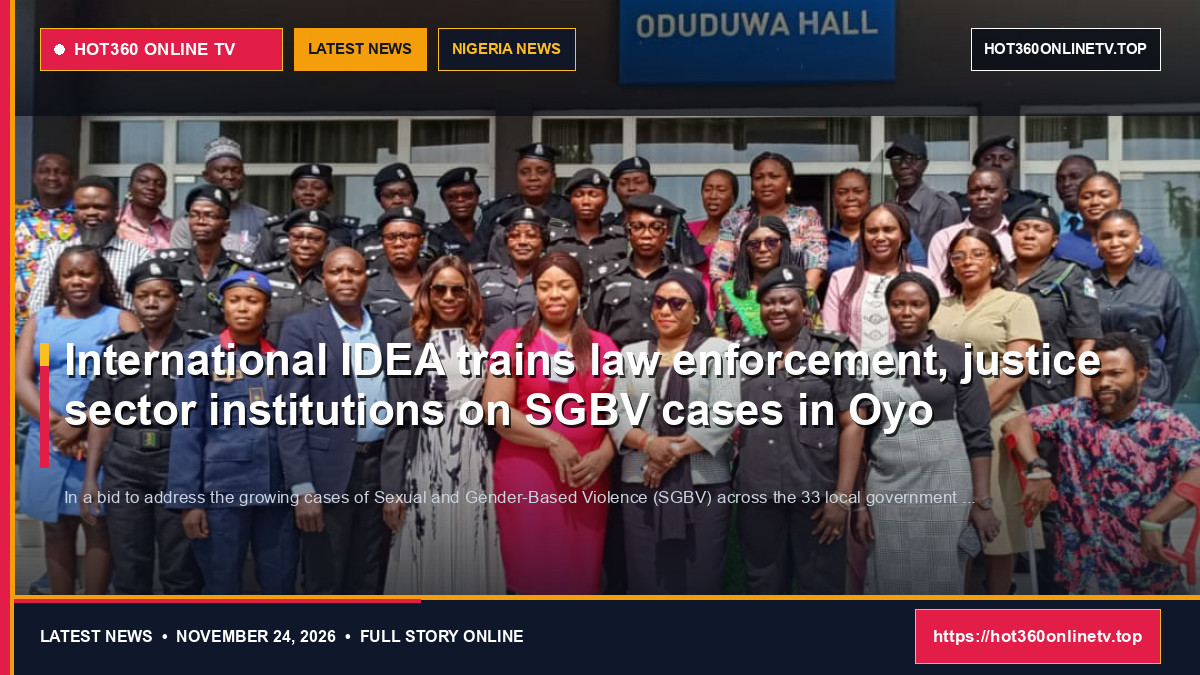
In a bid to address the growing cases of Sexual and Gender-Based Violence (SGBV) across the 33 local government areas of Oyo State, the International Institute for Democracy and Electoral Assistance (International IDEA) has commenced a multi-agency capacity-building training programme for law enforcement and justice sector institutions.
The training, which began on Tuesday, November 24, 2026, is organised by International IDEA with support from the European Union under the Ending Sexual and Gender-Based Violence in Nigeria (ESGBV) Programme.
The programme is designed to strengthen institutional capacity to prevent and respond to SGBV at the federal level, in the Federal Capital Territory and across its focal states of Oyo, Benue and Kaduna.
The four-day Training of Trainers (ToT) programme brings together prosecutors, investigators, gender desk officers and other justice sector professionals. It is expected to equip participants with the knowledge and practical skills needed to improve survivor-centred investigations, evidence management, case documentation, prosecution support, referrals and inter-agency collaboration.
Delivering the welcome address on behalf of International IDEA’s Senior Programmes Manager, Dr Mufuliat Fijabi, Mrs Juliet Olumuyiwa-Rufai, GBV Cross-Sector Service Provision and Protection Specialist, said the initiative was designed to improve institutional capacity and promote survivor-centred approaches to justice, protection and support services.
According to her, the training would equip participants with practical knowledge and skills in survivor-centred investigations, evidence management, case documentation, referrals, prosecution, survivor support and inter-agency coordination.
ALSO READ: ADC seeks probe over Kano gov’s comment on Supreme Court judgment
She stressed the importance of developing a pool of trained personnel who would transfer the knowledge acquired to their colleagues and promote best practices within their respective institutions.
“Your participation underscores the critical role your respective institutions play in ensuring that survivors receive timely, dignified and effective support, while perpetrators are held accountable in accordance with the law,” she said.
She further noted that the growing challenges posed by sexual and gender-based violence required coordinated, rights-based and effective institutional responses.
While urging participants to actively engage in the sessions, share experiences and approach the exercise with open minds, she said: “The knowledge and expertise you will acquire through this training will contribute to building stronger institutional systems that better protect survivors and improve justice outcomes.”
She also appreciated the European Union for its continued support and the Oyo State Government for its collaboration, expressing confidence that the programme would strengthen responses to SGBV and improve survivors’ access to justice.
Speaking on behalf of the Oyo State Attorney-General and Commissioner for Justice, the ministry’s Deputy Director of the Sexual and Gender-Based Violence Response Team, Barrister Kashifa Oloso-Olayiwola, commended the European Union and International IDEA for sustaining their partnership with the state government to strengthen justice delivery and protect women, girls and other survivors of sexual and gender-based violence.
She described the training as timely and strategic, noting that although Oyo State had made significant progress in establishing legal and policy frameworks to address SGBV, gaps in investigation, evidence management, case handling, prosecution support and referral coordination continued to undermine survivors’ access to justice.
According to her, the existence of laws alone could not guarantee justice unless the institutions responsible for enforcing them had the necessary capacity, commitment and coordination to translate their provisions into effective action.
She stressed that a survivor-centred justice system must go beyond technical investigation and prosecution to embrace trauma-informed responses, child safeguarding, disability inclusion and effective measures to address emerging forms of abuse, particularly technology-facilitated SGBV.
Oloso-Olayiwola maintained that survivors who approached law enforcement agencies for assistance must encounter institutions that offered protection, support and accountability rather than expose them to further trauma.
She urged the nominated prosecutors, investigators, gender desk officers and other participants to regard their selection for the training as an institutional responsibility rather than merely an opportunity for personal development.
She said the participants were expected to return to their respective agencies as trainers and mentors, sharing the knowledge acquired and helping to establish effective standards for handling SGBV cases.
The Ministry of Justice, she added, remained committed to working with International IDEA, the European Union, law enforcement agencies and civil society organisations to ensure that perpetrators were prosecuted and survivors received justice and were treated with dignity.
Also speaking at the opening session, the State Legal Officer of the Oyo State Police Command, CSP Oluwafunke Adu, described the training as an important intervention in strengthening operational policing and ensuring that investigations and prosecutions of SGBV cases complied with relevant laws and established procedures.
Adu, who spoke on behalf of the Police Command, appreciated the Commissioner of Police for approving and supporting collaboration among relevant departments and units, particularly the State Criminal Investigation Department (SCID), Gender Desk, Juvenile Welfare Centre (JWC) and Directorate of Legal Services.
She also acknowledged the contributions of the European Union and International IDEA through the ESGBV Programme, stressing that effective responses to sexual and gender-based violence required strong institutions, competent personnel and seamless cooperation among relevant agencies.
She emphasised that police officers, particularly those working in the Juvenile Welfare Centre and Gender Desk, must recognise that their responsibilities extended beyond investigating offences to protecting vulnerable individuals and ensuring that survivors were treated with empathy, dignity and professionalism.
According to her, the quality of a survivor’s first encounter with law enforcement officers could significantly influence their confidence in the justice system and willingness to pursue justice.
Adu explained that the training would address four critical areas of law and practice, including the Oyo State Child’s Rights Law, survivor-centred SGBV response, the Violence Against Persons (Prohibition) Law of Oyo State and general criminal law and procedure.
On child protection, she drew attention to Section 1 of the Oyo State Child’s Rights Law 2006, which establishes the best interests of the child as the primary consideration in all decisions and actions affecting children.
She urged officers to adopt child-friendly and trauma-informed approaches when handling cases involving child victims and witnesses, including those relating to physical abuse, trafficking, child labour, defilement and harmful traditional practices such as female genital mutilation.
She also cautioned against detaining children in conflict with the law alongside adult suspects or subjecting them to coercive interrogation. She stressed the importance of notifying parents, collaborating with social welfare officers and complying with family court procedures.
On the handling of SGBV cases, the police legal officer warned against treating domestic and sexual violence as private or family disagreements that could be resolved through informal settlements.
She maintained that offences such as rape, defilement and aggravated sexual assault must be treated in accordance with the law. She also warned officers against pressuring survivors to withdraw complaints or facilitating settlements in exchange for financial inducements.
She further highlighted the importance of immediate safety measures, prompt medical attention, preservation of forensic evidence and effective referral arrangements, particularly for survivors living with disabilities who might require additional protection and communication support.
Adu also underscored the need for officers to familiarise themselves with the provisions of the Violence Against Persons (Prohibition) Law of Oyo State 2021, which provides legal protection against several forms of physical, sexual, psychological and economic abuse.
She noted that the law addresses offences including domestic violence, spousal battery, economic abuse, stalking, harmful widowhood practices and other forms of abuse, while also providing for protection orders for survivors.
She urged investigators to pay greater attention to technology-facilitated SGBV, including cyberstalking, online sexual harassment, extortion and the non-consensual circulation of intimate images. She noted that electronic evidence and digital footprints must be properly preserved to support successful prosecutions.
On evidence management and prosecution, Adu stressed that successful court proceedings began with thorough and professional investigations at police stations.
She urged investigating officers to ensure that every element of an alleged offence was supported by credible evidence while maintaining proper documentation, authenticating medical reports and preserving an unbroken chain of custody for forensic and digital exhibits.
She also called for compliance with the provisions of the Administration of Criminal Justice Law of Oyo State and the Evidence Act 2011, particularly in recording confessional statements and handling evidence intended for court proceedings.
The police legal officer further emphasised the importance of timely legal advice, prompt forwarding of case files to the Directorate of Legal Services and the Ministry of Justice, and sustained collaboration among law enforcement and prosecution agencies.
She urged participants to maximise the opportunity provided by the training, share practical experiences and return to their respective divisions, area commands and departments to train colleagues and strengthen institutional capacity.
According to International IDEA, the overall objective of the four-day programme is to improve justice and protection outcomes for SGBV survivors by strengthening the capacity of law enforcement and justice sector institutions to investigate, prosecute and coordinate responses to reported cases.
Other specific objectives include improving the capacity of prosecutors, investigators and gender desk officers to manage SGBV cases effectively; promoting survivor-centred, child-sensitive and disability-inclusive approaches; strengthening evidence management and case-building; and improving referral systems and information-sharing among relevant institutions.
The programme also seeks to establish a pool of trained personnel who will serve as institutional trainers and mentors, ensuring that the knowledge and professional standards acquired are sustained and replicated across the participating states and the Federal Capital Territory.
Beyond law enforcement and prosecution, the ESGBV Programme also targets improved coordination among government institutions, particularly ministries responsible for women’s affairs, as well as enhanced access to essential response and protection services for survivors in rural and conflict-affected communities.
It also seeks to strengthen policies, procedures and protocols for responding to technology-facilitated SGBV, an emerging form of abuse that increasingly requires specialised investigative and support mechanisms.
Other stakeholders participating in the four-day training programme include the Nigeria Security and Civil Defence Corps (NSCDC), Federal Ministry of Justice, Oyo State Ministries of Women Affairs and Social Inclusion, Education, Science and Technology, and Health; the National Agency for the Prohibition of Trafficking in Persons (NAPTIP); the Inter-Ministerial Management Committee on the Eradication of Sexual and Gender-Based Violence; and other relevant stakeholders.
• Back to School, Back to Business A Fresh Start
• Relationship Hangout: Public vs Private Proposals – Which Truly Wins in Love?
“No” Is a Complete Sentence: Why You Should Stop Feeling Guilty
• “No” Is a Complete Sentence: Why You Should Stop Feeling Guilty
Relationship Hangout: Friendship Talk 2025 – How to Be a Good Friend & Big Questions on Friendship
• Relationship Hangout: Friendship Talk 2025 – How to Be a Good Friend & Big Questions on Friendship
Police Overpower Armed Robbers in Ibadan After Fierce Struggle
• Police Overpower Armed Robbers in Ibadan After Fierce Struggle
Get real-time news updates from Tribune Online! Follow us on WhatsApp for breaking news, exclusive stories and interviews, and much more. Join our WhatsApp Channel now