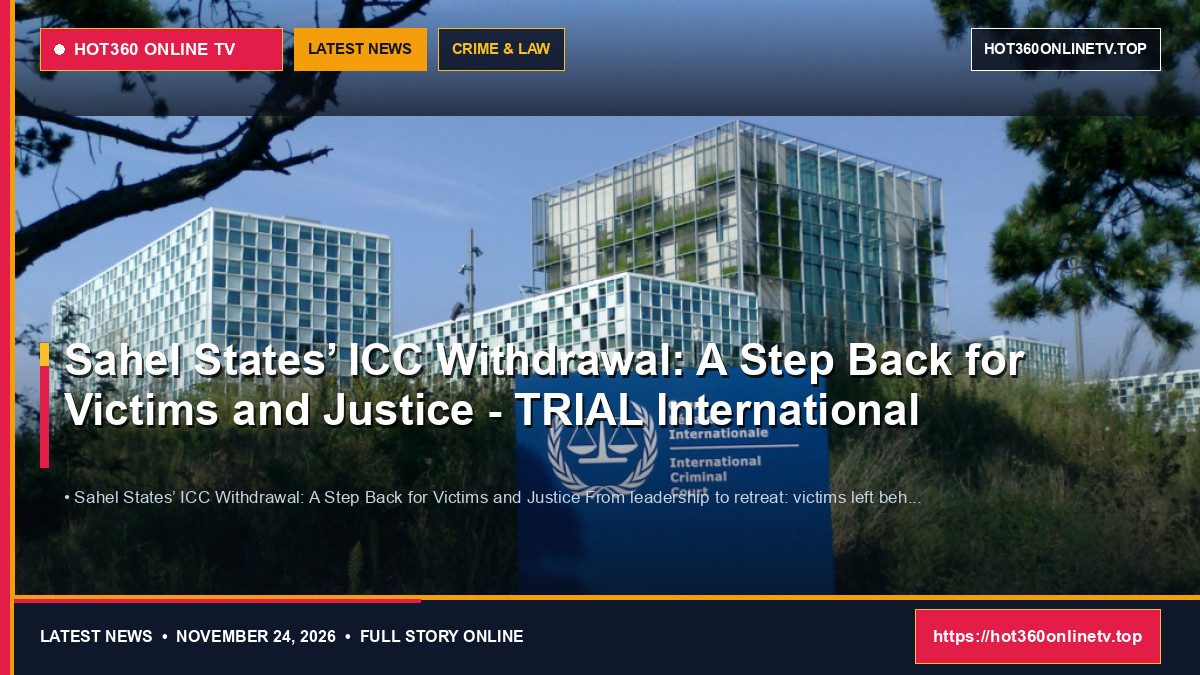
• Sahel States’ ICC Withdrawal: A Step Back for Victims and Justice
From leadership to retreat: victims left behind
African states played a leading role in the creation of the Court in 1998, overwhelmingly ratifying the Rome Statute, even referring their own situations to the Court. Their engagement gave victims of grave crimes a vital international ally when justice was not possible at home. The announced withdrawals reverse this history of leadership, leaving victims with fewer avenues to seek justice.
The decision follows the three states’ departure in January 2025 from the Economic Community of West African States (ECOWAS) – another institution they helped shape and which had built a strong human rights record through its Court of Justice. Such withdrawals signal a retreat from accountability, leaving victims without recourse, eroding human rights protections, and deepening isolation at a moment when regional and international cooperation is most needed, particularly in those countries grappling with atrocities linked to terrorism.
“The decision to withdraw from the ICC weakens the position of victims, for whom the Court often represents the last hope to obtain justice. After their withdrawal from ECOWAS, the loss of ICC protection leaves victims in Burkina Faso, Mali, and Niger with no recourse for the serious human rights violations they continue to endure.” said Drissa Traoré, Secretary General of FIDH. “In these countries affected by a multi-dimensional crisis, national courts are still unable to provide justice and reparation to the victims, mainly due to a lack of political will and incapacity to investigate war crimes and crimes against humanity.”
A blow to international justice at a fragile moment
The announced withdrawals by Burkina Faso, Mali and Niger come at a time when international justice is under increasing strain. Earlier this year, Hungary also announced its intention to leave the Rome Statute, in a move widely criticised as undermining global accountability.
While the ICC has previously received criticisms regarding the selectivity of cases brought before it and for its perceived overfocus on Africa, the Court has gradually worked to strengthen universality in the implementation of its mandate, broadening its reach far beyond Africa, with active investigations and cases in Afghanistan, Bangladesh/Myanmar, Palestine, Ukraine, Venezuela, Libya, and the Philippines. Recent arrests of Libyan suspects and the surrender of former President Rodrigo Duterte show that no region or power is immune from scrutiny. This universality strengthens the Court’s legitimacy – but also makes it more vulnerable to political attacks.
“States Parties must show resilience and reaffirm their commitment to the Court, to accountability, and to the rights of victims worldwide,” said Alix Vuillemain, Executive Director of Women’s Initiatives for Gender Justice (WIGJ). “At a time when the Court is under mounting attack, states must move towards universality, not retreat. Turning away now only fuels impunity.”
States’ role in safeguarding international norms
The role of the ICC in the broader international justice framework is significant. It complements, rather than replaces, existing mechanisms such as truth-seeking processes and transitional justice initiatives, which remain essential for lasting peace. The Rome Statute enshrines key principles that underpin international justice: no immunity for heads of state, complementarity with national jurisdictions, and the rights of victims to participate and seek reparations. Withdrawal from the Statute risks weakening these protections at the national level and eroding decades of progress in building global norms against impunity.
The GIAI urges all ICC States Parties to reaffirm their commitment to the Rome Statute. At a moment when victims in Africa and around the world are facing escalating violence, it is vital to preserve the ICC as a court of last resort.
*The Global Initiative Against Impunity for international crimes: Making Justice Work (GIAI) is a consortium of eight international NGOs and the Coalition for the ICC, co-funded by the European Union, which aims to contribute to the fight against impunity by supporting a comprehensive, integrated, and inclusive approach to justice and accountability for serious human rights violations and international crimes. This statement does not necessarily reflect the position of each of its member organisations.