Story Breakdown & Key Highlights
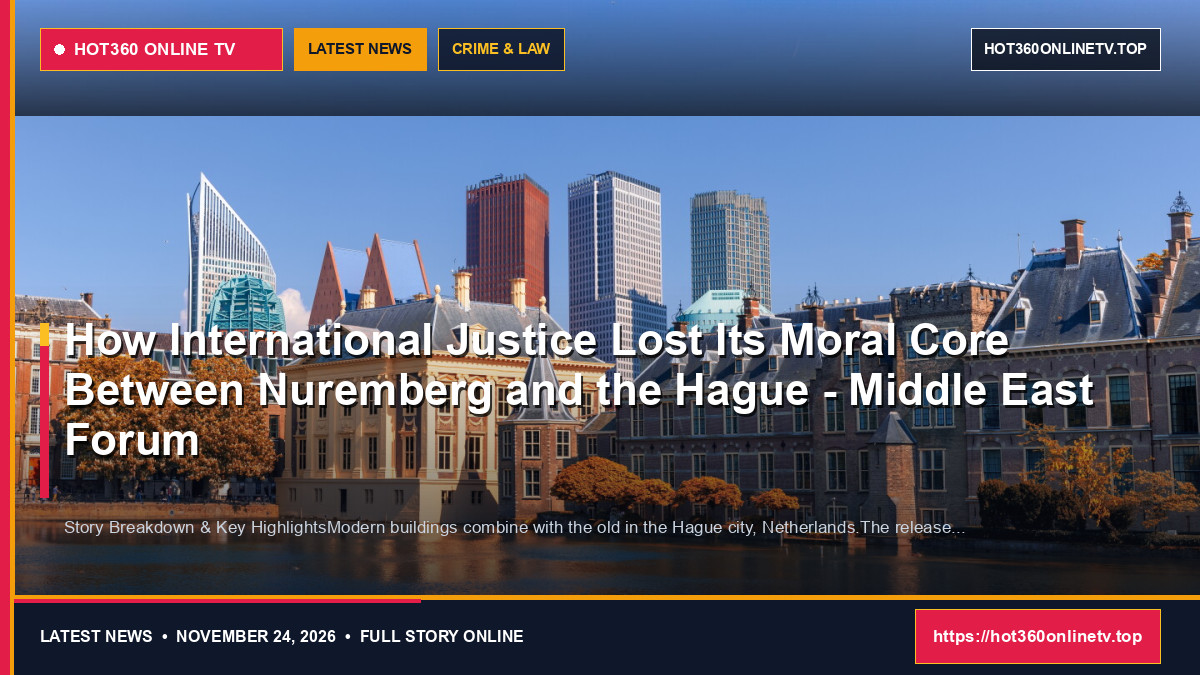
- Modern buildings combine with the old in the Hague city, Netherlands.
- The release of the new film Nuremberg, timed to the eightieth anniversary of the trials, arrives at a moment when the idea of international justice faces a profound crisis. The...
Full Report
Modern buildings combine with the old in the Hague city, Netherlands.
The release of the new film Nuremberg, timed to the eightieth anniversary of the trials, arrives at a moment when the idea of international justice faces a profound crisis. The film reminds viewers of a time when the world still spoke a common moral language—one rooted in a shared civilizational inheritance. Nuremberg rested on a Western understanding of individual responsibility, natural law, and the conviction that some acts were so evil that no political ideology could excuse them. The judges and prosecutors assumed a common framework of conscience and reason. Because of that shared foundation, Nuremberg could speak with clarity.
The International Court of Justice does not. Unlike the Nuremberg tribunal, today’s International Court of Justice draws its judges from legal, cultural, and political traditions that have no common philosophical core. The court is not built atop a shared moral inheritance; it is built upon a patchwork of competing civilizational visions—liberal, authoritarian, Islamic, socialist, postcolonial, and everything in between. The International Court of Justice, therefore, does not—and cannot—function as a universal court in the same way that Nuremberg did.
International Court of Justice judges often come from governments that reject Israel’s legitimacy or openly support its enemies.
International Court of Justice judges often come from governments that reject Israel’s legitimacy or openly support its enemies.
This is not a conjecture; it is the conclusion of substantial scholarship. Researchers from major law schools and political science departments have shown that international judges do not operate as neutral arbiters applying a single universal law. They bring with them the jurisprudence of their home states and the civilizational assumptions of the legal systems in which they were trained. Several studies have documented the influence of civil law, common law, and Islamic law traditions on International Court of Justice reasoning. Others show that judges vote in predictable coalition patterns—by political bloc, regional alignment, or shared ideological heritage, rather than by any neutral criteria.
This divergence from Nuremberg’s unity-of-principle has real consequences. When South Africa filed its case accusing Israel of genocide in Gaza, the International Court of Justice accepted a petition built on omission and propaganda. It entertained allegations that never would meet evidentiary standards in domestic courts. It overlooked the public admissions of Hamas leaders about their objectives. It ignored the fact that Israel faces an enemy whose explicit doctrine requires genocide. And it treated Israel—a democratic state defending itself after a mass atrocity—with the presumption of guilt. The court’s posture reflected not universal law, but a bench divided into political and civilizational camps.
Many analysts have observed that International Court of Justice judges often come from governments that reject Israel’s legitimacy or openly support its enemies. Several judges previously served as diplomats for states with entrenched positions against Israel. Others represent states that deny Israel’s right to self-defense or even its right to exist. This is part of the structural problem: the International Court of Justice contains judges who do not share a Western conception of individual responsibility, natural law, or liberal constitutionalism—ideas that formed the moral vocabulary of Nuremberg.
• Nuremberg rested on a unified moral framework; the International Court of Justice rests on none.
• Nuremberg assumed that conscience constrained the law; the International Court of Justice assumes that law is what diverse political cultures say it is.
• Nuremberg insisted on individual guilt; the International Court of Justice often treats nations collectively, according to political fashion and geopolitical pressure.
The International Court of Justice’s inconsistency becomes sharper in contrast to the International Criminal Court, which faces its own legitimacy crisis. Scholars and former prosecutors have noted selective enforcement, political targeting, and opaque decision-making. Studies show chronic delays, procedural inconsistency, and a pattern in which the International Criminal Court pursues weaker states while avoiding powerful or politically shielded regimes. All of this reflects the same structural problem: Without a common moral foundation, international criminal justice becomes political rather than principled.
By dramatizing a moment when the world still believed in universal moral responsibility, [the Nuremberg film] reminds what international justice once meant.
By dramatizing a moment when the world still believed in universal moral responsibility, [the Nuremberg film] reminds what international justice once meant.
The new Nuremberg film highlights this contrast in an unintentional way. By dramatizing a moment when the world still believed in universal moral responsibility, it reminds what international justice once meant. At Nuremberg, the judges stood on common philosophical ground; even Soviet judges were willing to consider and debate law despite the tremendous political pressure under which they found themselves. They believed in the universality of conscience, that individuals choose good or evil, and that law must reflect that truth.
That world no longer exists in The Hague. Today’s International Court of Justice reflects divided morality. It is not an institution of universal justice, but a chamber shaped by geopolitical blocs, civilizational traditions, and political interests. The decline since Nuremberg is not a matter of procedure or policy; it is a matter of foundations.
Nuremberg’s moral clarity cannot be recovered without the moral consensus that made it possible. Until the international community regains a shared understanding of human responsibility, international courts will continue speaking in fractured voices. The film Nuremberg reminds about the apex of international justice; the International Court of Justice increasingly represents its nadir.