Story Breakdown & Key Highlights
- NASA's long-distance spacecraft-calling network just got a boost.
- The Deep Space Network (DSN), best known for communicating with distant spacecraft such as Voyager 1, Voyager 2 and New Horizons, added a 114-foot (34-meter) radio-frequency...
Full Report
NASA's long-distance spacecraft-calling network just got a boost.
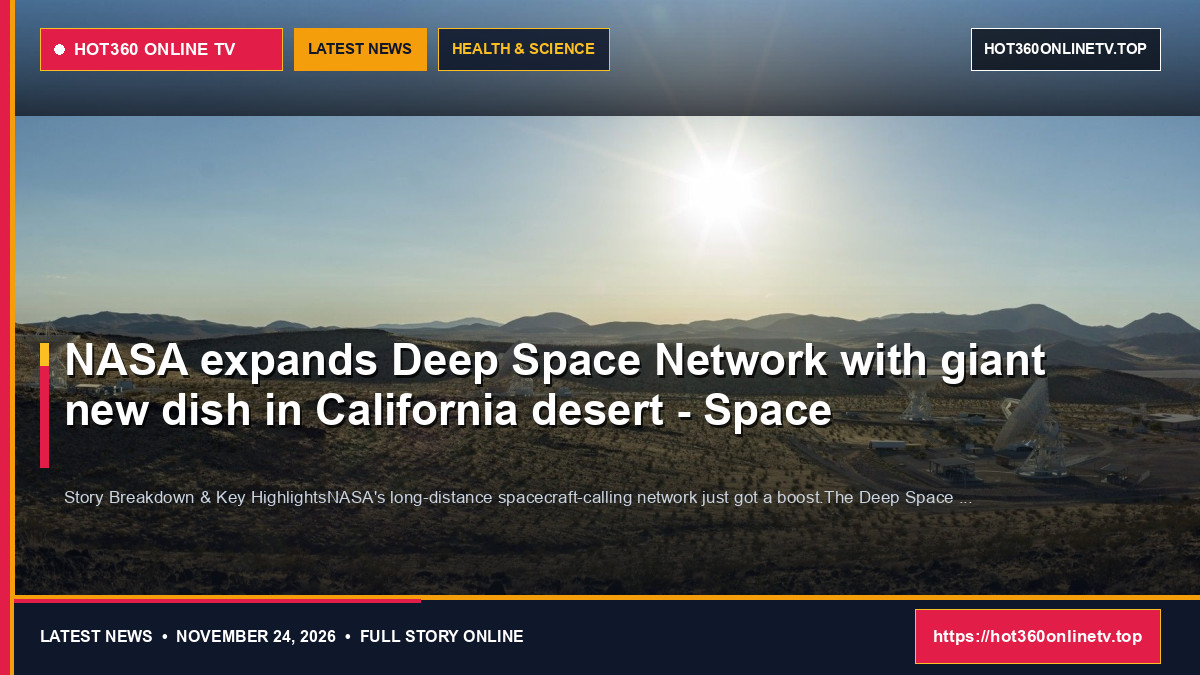
The Deep Space Network (DSN), best known for communicating with distant spacecraft such as Voyager 1, Voyager 2 and New Horizons, added a 114-foot (34-meter) radio-frequency antenna in California, boosting capacity on the increasingly crowded network.
More than 40 spacecraft exploring the solar system and interstellar space use DSN, which has struggled to keep pace with growing demand. Communications with the uncrewed Artemis 1 mission in 2022 and the crewed Artemis 2 mission in 2026 took priority as they traveled around the moon, substantially reducing the network's capacity to support other missions.
At least as early as 2021, managers were warning that despite ongoing efforts to add new antennas to DSN, the agency cannot reach all deep-space missions at once.
"We're trying to add capacity and more antennas, but we can't keep up with the demand that's currently out there, so missions should expect to be getting less availability," Brad Arnold, DSN manager at NASA's Jet Propulsion Laboratory (JPL), said during a presentation attended by Space News. Arnold also warned that the Artemis moon program would be "the gorilla in the room," because the astronauts by default have to be prioritized over robotic spacecraft: "That ultimately will affect our ability to service the rest of the missions."
That's because the DSN is designed to serve both human and robotic deep-space spacecraft. While JPL (then under contract to the U.S. Army) had three spacecraft radio-tracking stations in Nigeria, Singapore, and California ready for the early space program in 1958, the DSN with more powerful dishes was established in December 1963 as "the de facto network for missions into deep space," state JPL materials from the 50th anniversary celebration in 2013.
The DSN helped relay communications from Apollo 11's historic moonwalk by NASA astronaut Neil Armstrong's on July 20, 1969, and has since supported countless milestones. This includes images from Mars rovers starting in the 1990s and data showing that both Voyager 1 and Voyager 2 crossed into interstellar space in the 2010s.
These days, Artemis isn't the only extra demand on DSN; other space agencies also use the network for their own spacecraft, to a much greater degree than 50 years ago as space exploration has matured. NASA is also planning a permanent Moon Base near the lunar south pole as soon as the 2030s, although the agency does promise the base will, in its third phase, include "a coordinated lunar network supporting communications across Moon Base assets."
The DSN operates three complexes — at Goldstone in California, near Madrid in Spain and Canberra in Australia — each of which includes a large 230-ft (70m) antenna alongside several smaller dishes. The new antenna is about half that size and is co-located at Goldstone. It came online on Aug. 3, tracking NASA's Chandra X-ray Observatory.
DSS-23 is the fifth of six new 34-meter antennas planned under the DSN's Aperture Enhancement Project, which began in 2009. The project is expected to be completed when the sixth antenna, DSS-33, comes online at the Canberra complex in 2029.
The expansion has also taken longer and cost more than originally planned. A 2015 NASA Office of Inspector General report estimated the project at $362.4 million, but by the start of fiscal year 2023, expected costs had risen by 68% to $706 million and the project was nearly five years behind schedule. NASA now expects the final enhancement antenna to come online in 2029.