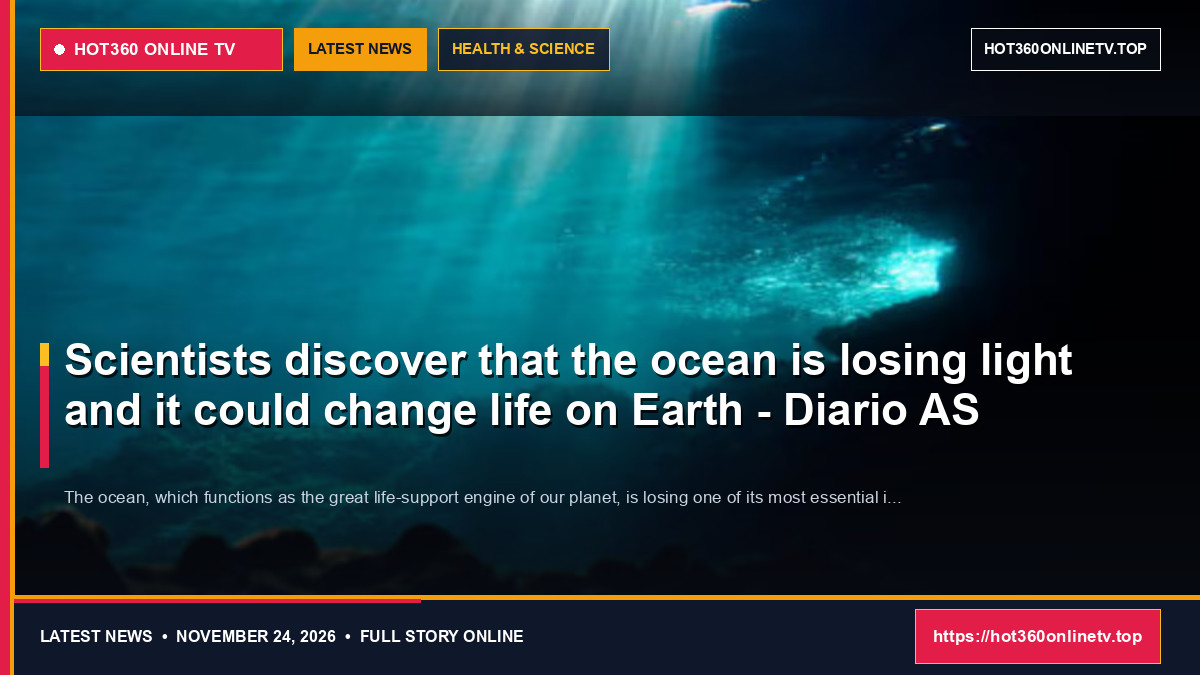
The ocean, which functions as the great life-support engine of our planet, is losing one of its most essential ingredients for sustaining life: sunlight. A study led by the Plymouth Marine Laboratory has raised alarm after detecting a phenomenon known as ocean darkening. This serious change prevents sunlight from penetrating the water as deeply as it once did and threatens to disrupt the global food chain.
A dramatic reduction of the photic zone
The main issue lies in the shrinking of the photic zone. This term refers to the upper layer of the ocean that sunlight can reach and where phytoplankton thrive. These microscopic plant-like organisms form the base of the entire marine food web.
This illuminated layer is crucial because it produces a significant portion of the oxygen we breathe while also absorbing carbon dioxide from the atmosphere.
The study’s results show that in just twenty years, between 2003 and 2022, more than 21 percent of the world’s oceans experienced this darkening. In more than 9 percent of ocean waters, the depth of the photic zone has decreased by more than 50 meters, with reductions exceeding 100 meters in some areas. This change directly affects millions of species that rely on light to hunt, feed, and reproduce.
OCEAN DARKENING ON CNN: PML's Prof Tim Smyth speaking to @kimbrunhuber on @CNN and @cnni this morning about his new study with Dr @Thomas_W_Davies (@PlymUni) that revealed a 21% reduction in sunlight zones vital for life in the sea. More: https://t.co/30xkdRNflw pic.twitter.com/9M1g01jB2G— Plymouth Marine Lab (@PlymouthMarine) May 30, 2025
OCEAN DARKENING ON CNN: PML's Prof Tim Smyth speaking to @kimbrunhuber on @CNN and @cnni this morning about his new study with Dr @Thomas_W_Davies (@PlymUni) that revealed a 21% reduction in sunlight zones vital for life in the sea. More: https://t.co/30xkdRNflw pic.twitter.com/9M1g01jB2G
Coastal fertilizers and open-ocean warming
Scientists point to a combination of natural and human-driven causes behind this “underwater blackout.” In coastal regions, the main factor is the excess nutrients entering the ocean from agricultural fertilizers, along with the buildup of sediments and mud. These materials cloud the water and make it more opaque.
In the open ocean, however, the main driver appears to be global warming. Rising temperatures have altered how phytoplankton grow and have changed the stratification of seawater, which refers to how warm and cold layers separate and mix. These shifts make it harder for sunlight to penetrate deeper into the ocean.
The regions experiencing the strongest impact include the North Atlantic, the Arctic, the Antarctic, and enclosed seas such as the Baltic Sea.
A risk for the planet: biodiversity and climate
The consequences of this loss of light are already becoming visible. As the illuminated layer shrinks, many marine species are forced to move closer to the surface in order to survive. This pushes large numbers of organisms into a much smaller space, increasing competition for food, raising biological stress, and leaving them far more exposed to predators, including human fishing vessels.
On a global scale, the danger may be even greater. If the photic zone continues to shrink, the ocean’s ability to carry out photosynthesis will also decline. This would weaken the ocean’s role as a carbon sink, its natural capacity to capture and store the carbon dioxide that warms the planet.
If that happens, one of the most important natural tools for combating climate change could be significantly weakened.
Get closer to the game! Whether you like your soccer of the European variety or that on this side of the pond, our AS USA app has it all. Dive into live coverage, expert insights, breaking news, exclusive videos, and more. Plus, stay updated on NFL, NBA and all other big sports stories as well as the latest in current affairs and entertainment. Download now for all-access coverage, right at your fingertips – anytime, anywhere.
And there’s more: check out our TikTok and Instagram reels for bite-sized visual takes on all the biggest soccer news and insights.
• Investigación científica