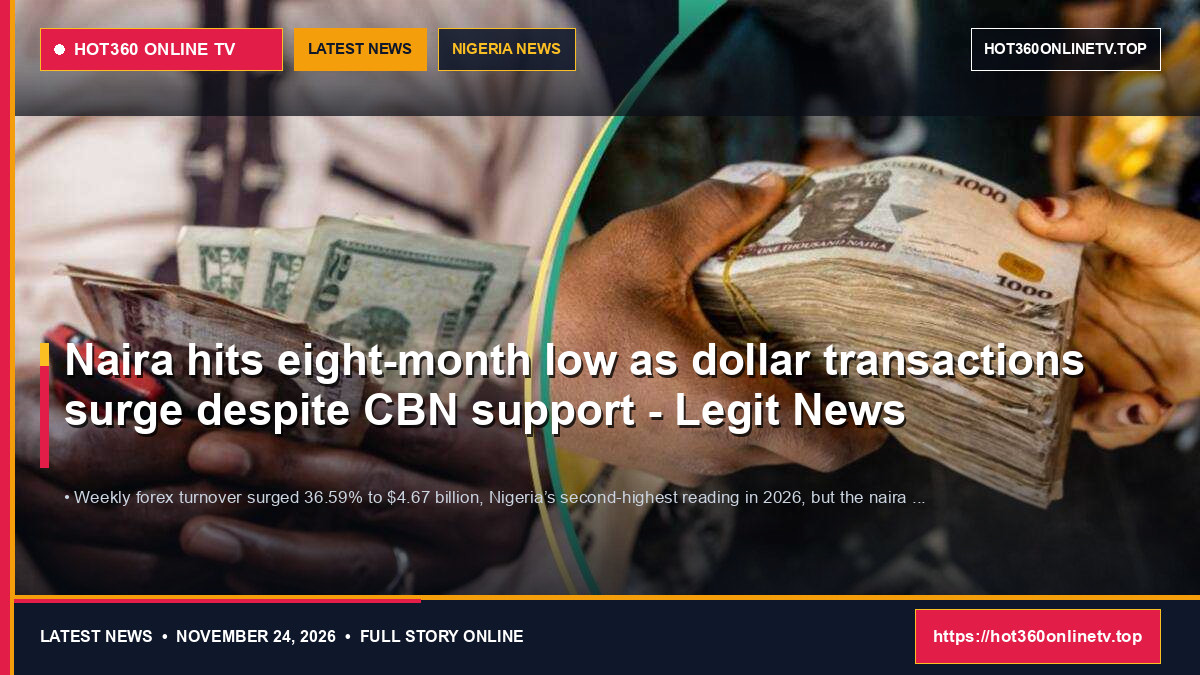
• Weekly forex turnover surged 36.59% to $4.67 billion, Nigeria’s second-highest reading in 2026, but the naira weakened against the dollar
• Foreign investor demand, election uncertainty and festive-season imports added pressure as reserves fell despite a $1.30 billion CBN intervention
• Dangote Refinery’s reported $4.5 billion in foreign IPO subscriptions could boost inflows, while depreciation risks higher import costs and inflation
PAY ATTENTION: Mark Legit.ng as a preferred source, and our content will appear higher in your Google feed!
Pascal Oparada is a journalist with Legit.ng, covering technology, energy, stocks, investment, and the economy for over a decade.
Nigeria’s foreign exchange market recorded a significant surge in trading activity in the week ended November 20, 2026, even as the naira suffered renewed depreciation amid mounting demand for the United States dollar.
Data from the FMDQ showed that foreign exchange turnover increased by 36.59 per cent to $4.67 billion, compared with $3.42 billion recorded in the preceding week.
The figure represents Nigeria’s second-highest weekly forex turnover in 2026, highlighting increased currency trading despite persistent exchange rate pressures.
CBN governor Cardoso announces MPC decision on new interest rate for banks, gives reasons
PAY ATTENTION: From breaking news to viral moments. Follow Legit.ng on Instagram!
However, the surge in transactions failed to strengthen the naira, raising concerns over the balance between foreign exchange supply and demand.
Dollar transactions surge across forex market
Spot transactions dominated market activities during the week, increasing by 43.08 per cent to $4.64 billion and accounting for 99.40 per cent of total turnover.
Conversely, forward transactions declined by 83.88 per cent to $28.19 million, reflecting a sharp reduction in agreements involving future currency exchanges.
Average daily forex turnover increased from $684.18 million to $934.50 million.
The latest weekly performance was surpassed only by the $5.06 billion recorded in the week ended August 21, 2026.
Naira weakens despite CBN’s dollar intervention
Despite increased market liquidity, the naira depreciated by 2.50 per cent at the official Nigerian Foreign Exchange Market (NFEM), closing at N1,394 per dollar on Friday, its weakest level in eight months.
The local currency began the week at N1,360 per dollar before coming under sustained pressure.
Naira falls by N4 against dollar as Nigeria’s external reserves lose $680 million
At the parallel market, the naira weakened by 2.33 per cent to N1,458 per dollar.
Cordros Securities attributed the depreciation to increased demand from foreign portfolio investors, which reportedly outweighed the Central Bank of Nigeria’s (CBN) $1.30 billion intervention during the week.
Meanwhile, Nigeria’s gross external reserves declined by $211.92 million to $54.65 billion as of November 19.
Election uncertainty threatens foreign capital inflows
The Chief Executive Officer of Wyoming Capital Partners, Tajudeen Olayinka, identified growing uncertainty surrounding the 2027 general elections as a factor influencing foreign investors’ decisions.
He explained that concerns about potential changes in economic policies could discourage investors from committing additional funds to Nigeria.
Foreign investor exits and rising demand for dollars to finance festive-season imports could also intensify pressure on the naira in the coming weeks.
Forward market rates reflected similar concerns, with the one-year forward exchange rate weakening to N1,597.57 per dollar.
Dangote Refinery offer raises inflow hopes
Meanwhile, Dangote Refinery’s initial public offering, which reportedly attracted nearly $4.5 billion in foreign subscriptions, has emerged as a potential source of foreign exchange inflows.
Dollar nears N1,400 as CBN faces pressure to sustain naira’s gains
The Head of Research at IRON Capital Partners, Abiodun Ogunniyi, noted that currency conversions associated with foreign subscriptions could contribute to increased forex market activity.
However, analysts stressed the need for a detailed examination of transactions to establish the actual drivers of rising turnover.
CBN faces fresh exchange rate challenges
The developments come amid the CBN’s Monetary Policy Committee meeting scheduled for November 23 and 24, with exchange rate stability, inflation and market liquidity remaining major concerns.
Cordros Securities expects foreign exchange demand pressures to persist through the remainder of 2026, citing weaker net foreign inflows and investor caution.
Nevertheless, the investment firm believes Nigeria’s external reserves remain sufficient to support continued CBN intervention.
For businesses and households, sustained naira depreciation could translate into higher import costs and renewed inflationary pressures ahead of Christmas.
Naira falls: CBN releases fresh FX rate
Legit.ng earlier reported that the Nigerian naira has weakened to its lowest level in four months against the United States dollar, raising fresh concerns over exchange rate stability as businesses and importers prepare for the end-of-year trading season.
Official foreign exchange data from the Central Bank of Nigeria (CBN) showed that the naira depreciated to N1,376.5807 per dollar at the Nigerian Foreign Exchange Market (NFEM), its weakest level since July 2026.
Pascal Oparada (Business editor) For over a decade, Pascal Oparada has reported on tech, energy, stocks, investment, and the economy. He has worked in many media organizations such as Daily Independent, TheNiche newspaper, and the Nigerian Xpress. He is a 2018 PwC Media Excellence Award winner. Email:pascal.oparada@corp.legit.ng