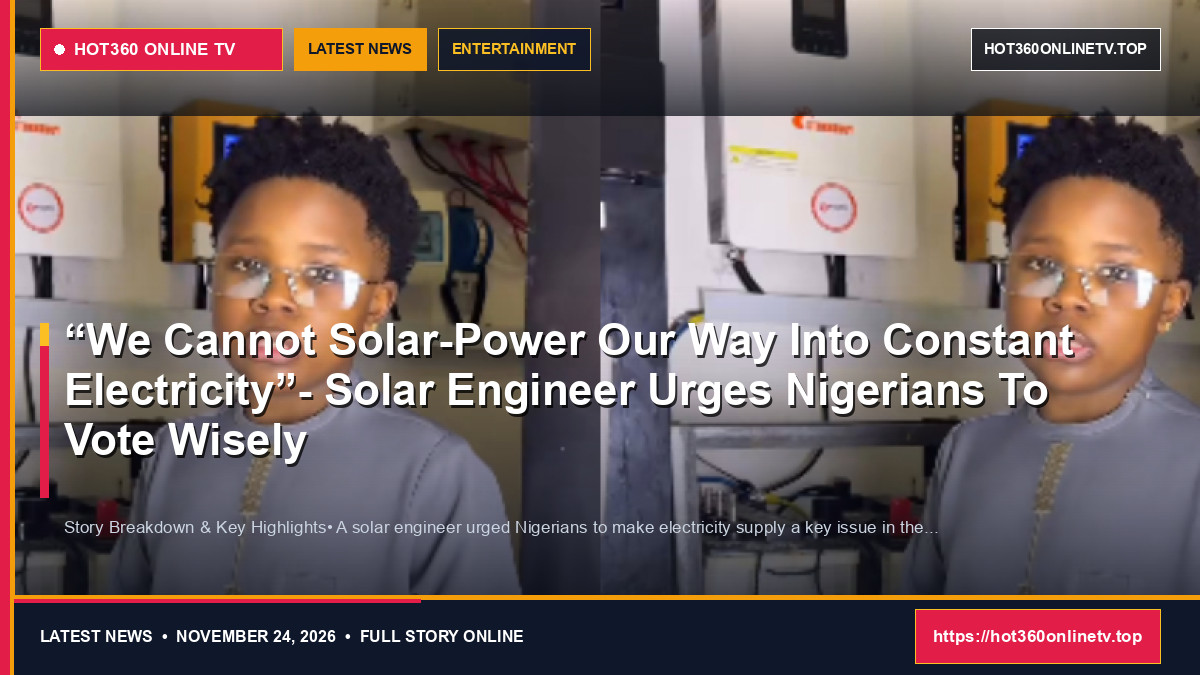
Story Breakdown & Key Highlights
- • A solar engineer urged Nigerians to make electricity supply a key issue in the 2027 presidential election.
- • The engineer warned that solar power alone cannot solve the country’s electricity problems.
Full Report
• A solar engineer urged Nigerians to make electricity supply a key issue in the 2027 presidential election.
• The engineer warned that solar power alone cannot solve the country’s electricity problems.
• Even people and businesses using alternative energy remain affected by the unreliable national grid.
A solar engineer has urged Nigerians to pay close attention to issues surrounding electricity supply as they prepare for the 2027 presidential elections, warning that relying on solar energy cannot completely solve the country’s power challenges.
The engineer explained that even businesses and individuals who have invested in alternative power sources are still affected by the unreliable electricity supply from the national grid.
Sharing his recent experience, he disclosed that his business had been operating with a combination of 30 per cent electricity from the national grid, commonly referred to as NEPA, and 70 per cent solar power.
However, he said the situation had worsened within a week, as the electricity supply from the national grid had dropped almost to zero.
According to him, the development has forced him to consider purchasing a bigger battery and inverter to keep his operations running, resulting in additional and unexpected expenses.
Explaining why he decided to speak out despite being in the solar business, the engineer noted that having an alternative solution to a problem could make people forget that the problem still exists and continues to affect others.
He said, “Vote wisely! I know I shouldn’t be saying this because it’s bad for my business, but we cannot solar-power our way into constant electricity.
“Just last week, we were managing with 30% electricity from NEPA and 70% from solar. But this week, even the 30% electricity we were getting from NEPA has dropped almost to zero.
“Now, we have to go out and get a bigger battery and a bigger inverter, which means more unexpected expenses.
“I’m saying this because when you have your own solution to a problem, it’s easy to forget that the problem still exists and assume it cannot affect you.”
His comments have sparked conversations about Nigeria’s electricity challenges and the need for sustainable solutions beyond individual investments in solar power, particularly as the country approaches the 2027 general elections.