Story Breakdown & Key Highlights
- For much of the democratic era, many African governments have approached South Africa through a simple diplomatic and reductive calculation: maintain strong relations with the...
- The ANC is no longer the uncontested political force it once was. Declining electoral support, mounting governance failures, persistent unemployment, deteriorating infrastructure,...
Full Report
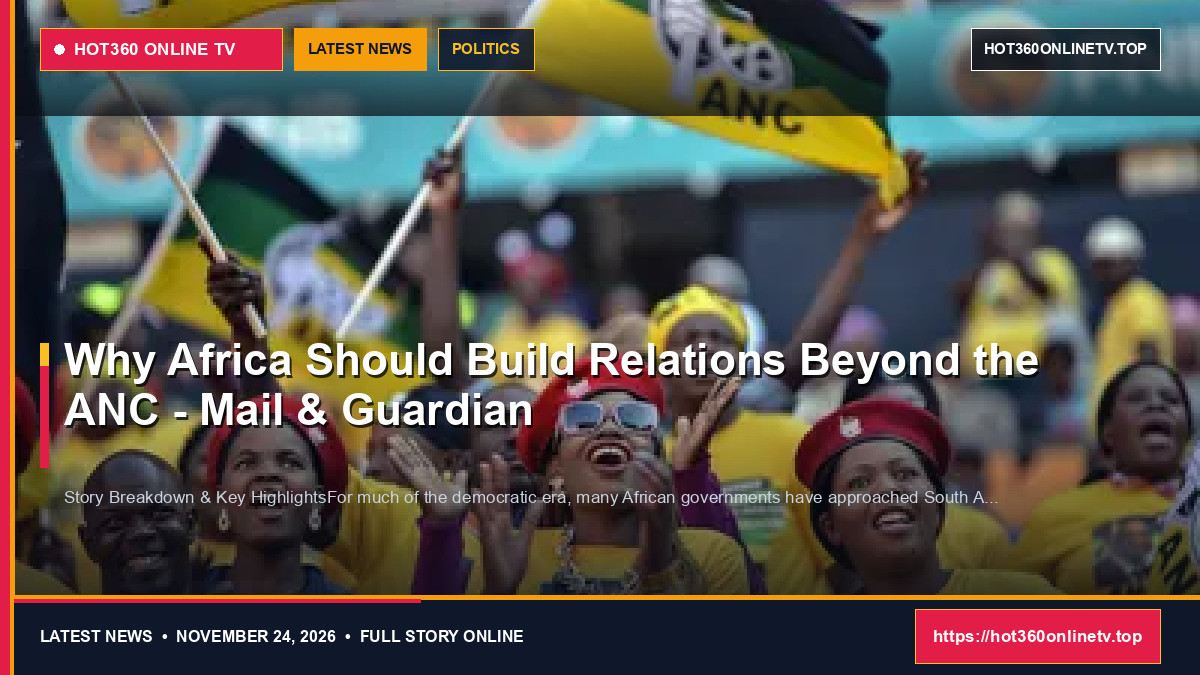
For much of the democratic era, many African governments have approached South Africa through a simple diplomatic and reductive calculation: maintain strong relations with the African National Congress (ANC) and, as an afterthought, South Africa itself. This assumption has shaped regional politics since 1994, when the ANC emerged not merely as South Africa's governing party but as a symbol of African liberation and post-colonial solidarity. Yet, as South Africa undergoes profound political change, this strategy increasingly appears short-sighted. Electoral cycles, including recent local government elections that function as de facto mid-term contests within the South African political system, provide a useful basis for analytical inference.
The ANC is no longer the uncontested political force it once was. Declining electoral support, mounting governance failures, persistent unemployment, deteriorating infrastructure, and public frustration over service delivery have fundamentally altered the country's political landscape. The assumption that the ANC and South Africa are one and the same is becoming increasingly difficult to sustain. Indeed, one of the major miscalculations made by some African governments may have been their tendency to cultivate relationships primarily with the governing party while paying insufficient attention to the evolving sentiments of ordinary South Africans.
More significantly, South Africa appears to have quietly ruptured from the liberation-struggle paradigm that dominated much of its political identity during the first decades of democracy. Among a growing segment of the electorate, particularly younger voters with no living memory of apartheid, it is tacitly accepted that liberation-era ideology has reached its political expiration date. While the ANC continues to host and maintain relations with so-called fraternal liberation movements across the continent, as demonstrated by periodic summits and solidarity gatherings, these symbolic connections no longer command the same legitimacy among ordinary citizens. Increasingly, South Africans evaluate both domestic and foreign policy through the lens of governance performance, economic opportunity, public safety, and state capacity rather than liberation credentials. Consequently, many citizens have distanced themselves from the leftist internationalism that historically informed South Africa's post-apartheid diplomacy, preferring a more pragmatic and nationally focused approach to regional relations.
For many South Africans, particularly among the poor and working classes, immigration is increasingly viewed through the lens of economic competition. In communities struggling with unemployment, inadequate housing, overstretched healthcare facilities, and failing public services, migrants are often perceived as competitors for scarce resources. While scholars and policymakers rightly caution against simplistic explanations that blame migrants for structural economic problems, it would be equally mistaken to dismiss the reality that immigration has become a central political concern for millions of South Africans.
Yet many governments across the continent have remained largely silent on the domestic pressures generated by migration into South Africa. The prevailing attitude often appears to be that as long as South Africa continues to absorb migrants and sustain regional economic opportunities, the issue can be left for Pretoria to manage. This silence may yield short-term benefits, but it risks creating long-term resentment among South Africans who increasingly feel that their concerns are ignored both by their own government and by neighbouring states.
A growing disconnect is therefore emerging between official diplomacy and public sentiment. While political elites continue to invoke the language of African solidarity, a significant portion of the South African electorate has become more sceptical about regional integration, open migration regimes, and multilateral commitments. This divergence carries important implications for the future.
The rise of political movements advocating stricter immigration controls reflects this changing mood. More importantly, parties that are openly supportive of expansive migration policies have generally struggled to convert those positions into broad-based electoral support among large sections of the black majority electorate. Voters may differ on many issues, but concerns regarding border management, illegal immigration, and state capacity increasingly cut across ideological lines.
This does not necessarily mean that South Africa is moving toward isolationism. However, it does suggest that future governments, regardless of political affiliation, may face growing pressure to adopt more restrictive approaches to migration and regional engagement than those pursued during the early decades of democracy. The era when foreign policy could be justified primarily through appeals to liberation solidarity may be drawing to a close.
Should the ANC continue to lose support, future administrations may feel less bound by the ideological commitments that shaped South Africa's post-apartheid foreign policy. Instead, they may prioritise a more explicitly national-interest-driven approach. Such a shift could affect South Africa's participation in regional and international institutions, including the Southern African Development Community (SADC), the African Union (AU), and aspects of the international refugee protection regime established under the 1951 United Nations Refugee Convention.
To be clear, speculation about South Africa withdrawing from institutions such as the AU, SADC, or international refugee agreements remains precisely that: speculation. Such decisions would involve significant political, economic, diplomatic, and legal consequences. Nevertheless, the fact that these possibilities are increasingly discussed in public discourse points to a deeper underlying reality. A growing number of South Africans are questioning whether existing regional arrangements adequately serve their interests.
African governments would therefore be wise to recognise that South Africa's political future may not resemble its political past. Building sustainable relationships with South Africa requires honest engagement not only with governments and political elites but also with citizens, civil society, local communities, businesses, and public opinion. Diplomacy that ignores the electorate risks becoming detached from democratic reality.
The lesson is straightforward. Political parties come and go; nations endure. The ANC's historic contribution to South Africa's liberation is undeniable, but it cannot be assumed that the party will indefinitely define South Africa's national interests or political identity. As democratic competition reshapes the country's future, African leaders must learn to distinguish between the government of the day and the people themselves. Those who fail to appreciate this distinction may discover, too late, that the South Africa emerging in the coming decades will be guided less by the ideals of liberation solidarity and more by the demands of an electorate increasingly concerned with sovereignty, borders, accountability, and national interest.
In a rapidly changing political environment, the most durable relationships will not be those built with parties, but those built with peoples.
Dr Mabutho Shangase is a senior lecturer in Political Studies and International Relations at North-West University. @nativconscience