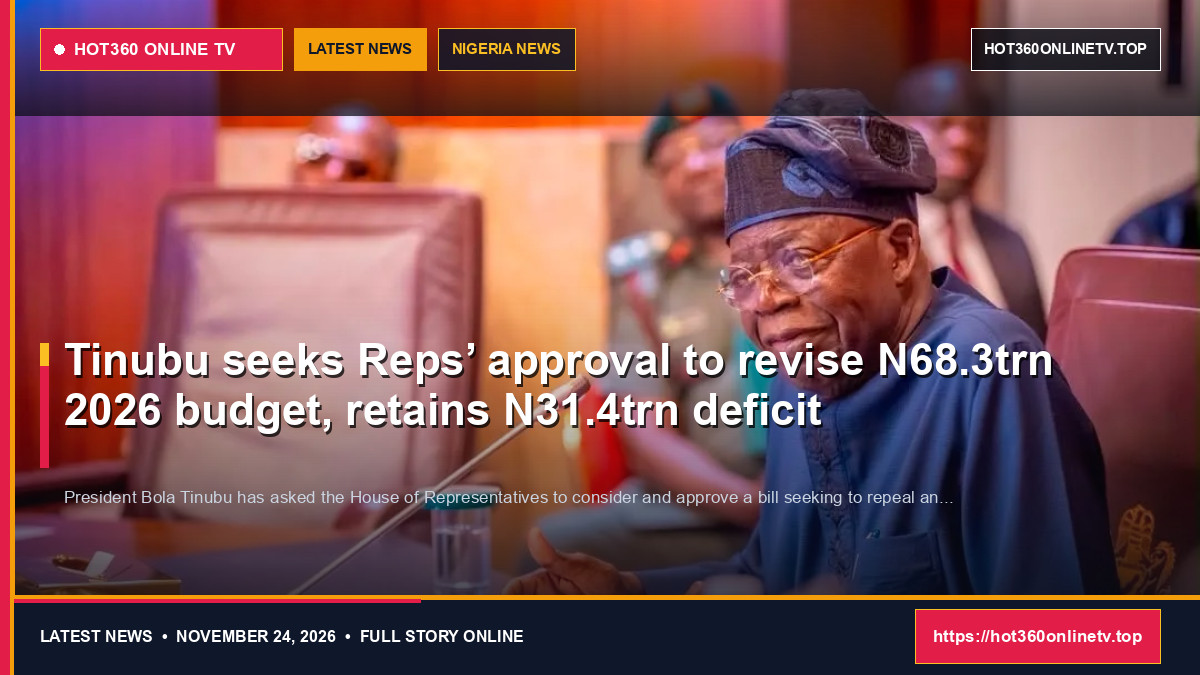
President Bola Tinubu has asked the House of Representatives to consider and approve a bill seeking to repeal and reenact the 2026 Appropriation Act, proposing a reduction in total government expenditure while retaining the N31.45 trillion fiscal deficit and N29.21 trillion borrowing plan.
Join the Premium Times WhatsApp Community For Quick Access To News and Happenings Around You.
Mr Tinubu made the request in a letter dated 20 November 2026 and addressed to the House. The Speaker, Abbas Tajudeen, read the letter during Tuesday’s plenary.
The proposed legislation, titled Transmission of FGN 2026 Appropriation Repeal and Reenactment Bill and Revised 2026 Federal Government Fiscal Framework, seeks to realign the 2026 budget with what the president described as existing government obligations and available resources.
Under the revised framework, total expenditure is projected at N65.176 trillion, down from the N68.323 trillion approved earlier in the year, representing a reduction of N3.147 trillion.
Projected federal government revenue, including that of government-owned enterprises, stands at N33.720 trillion, while capital expenditure is put at N26.232 trillion.
Despite the reduction in expenditure, the fiscal deficit remains unchanged at N31.457 trillion, equivalent to 5.64 per cent of the Gross Domestic Product (GDP).
Why Tinubu wants to revise the budget
Explaining the proposed adjustments, Mr Tinubu said the revision would regularise some expenditures incurred by the Nigerian National Petroleum Company Limited (NNPCL) on behalf of the federation and address underprovided debt-service obligations.
Stay Ahead with Premium Times
Follow us on Google News and never miss breaking stories, investigations, and in-depth reporting.
The revised budget also recognises issued capital warrants and supplementation commitments and provides for refunds to Ministries, Departments and Agencies (MDAs) and Special Accounts.
“It regularises some NNPCL expenditures incurred on behalf of the Federation, addresses underprovided debt-service obligations, recognises issued capital warrants and supplementation commitments, and provides for refunds to Ministries, Departments and Agencies (MDAs) and Special Accounts,” it read.
According to the president, most of the revised MDA capital provisions consist of amounts already warranted, while a few new allocations have been introduced for priority interventions.
These include the completion of critical road projects, protection of agricultural production, reduction of production costs, improvement of farm yields and market access, as well as measures to address water vulnerability.
He said the adjustments would improve the credibility and execution of the capital budget while maintaining fiscal restraint.
Borrowing plan unchanged
The president said the government would retain its N29.218 trillion borrowing plan, comprising N18.428 trillion in domestic borrowing and N10.790 trillion in foreign borrowing.
He also explained that the proposed US$7.7 billion external borrowing, equivalent to approximately N10.368 trillion at the exchange rate of N1,346.50 to the dollar, would finance the existing foreign borrowing provision and would not increase the borrowing envelope.
The retention of the deficit and borrowing targets means the proposed revision focuses largely on adjusting expenditure and accommodating existing obligations rather than reducing the government’s overall financing gap.
After reading the request, Mr Tajudeen referred it to the committee on appropriation for further legislative work.
Background
The latest request marks another adjustment to the 2026 budget, which has undergone changes since its presentation to the National Assembly.
Mr Tinubu initially presented a N58.18 trillion budget proposal to a joint session of the National Assembly on 19 December 2025.
However, the proposal was reviewed upwards in March 2026 following a request by the president to accommodate outstanding capital commitments and priority projects.
The National Assembly subsequently approved N68.323 trillion on 31 March 2026, and Mr Tinubu signed the budget into law on 17 April 2026.
The latest proposal seeks to reduce the approved expenditure by N3.147 trillion while retaining the existing deficit and borrowing targets.
Discover more from Premium Times Nigeria
Subscribe to get the latest posts sent to your email.