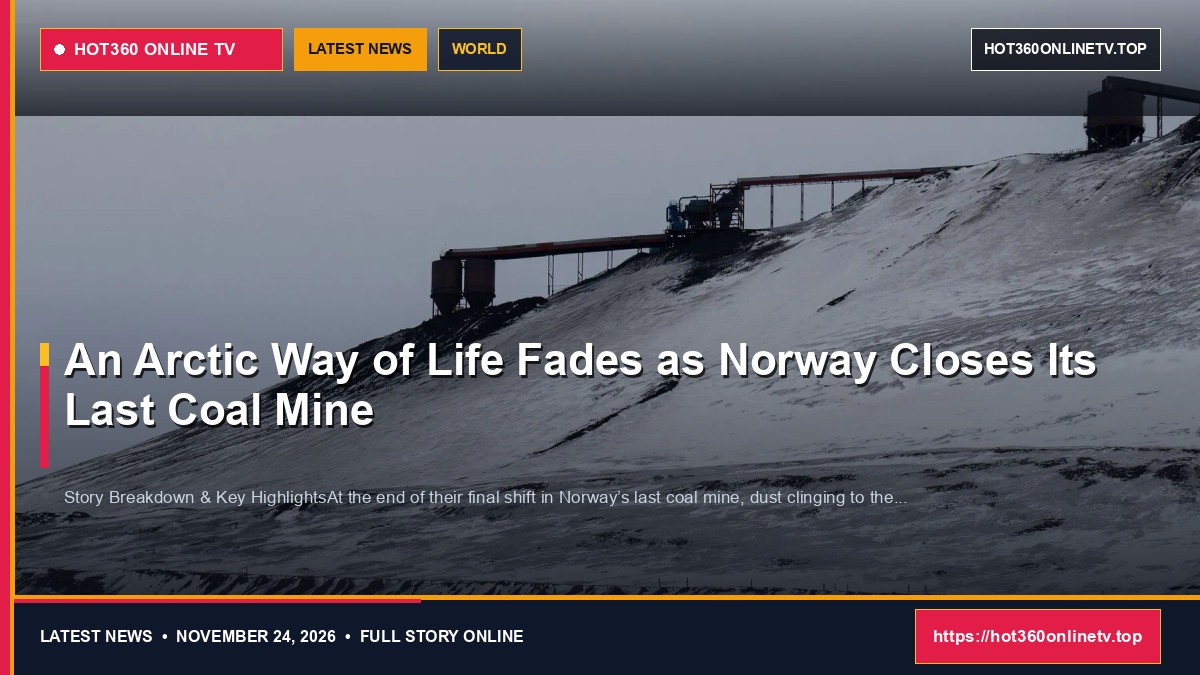
Story Breakdown & Key Highlights
- At the end of their final shift in Norway’s last coal mine, dust clinging to their overalls, the miners stopped work to listen to a solemn song.
- The one who performed, in his hard hat, strummed a guitar as he sang, “We are a coal mining problem in a tourist town.”
Full Report
At the end of their final shift in Norway’s last coal mine, dust clinging to their overalls, the miners stopped work to listen to a solemn song.
The one who performed, in his hard hat, strummed a guitar as he sang, “We are a coal mining problem in a tourist town.”
It was a lament for a way of life at Mine 7, on Svalbard, an ice-covered, Norwegian-controlled archipelago not far from the North Pole. The mine was unprofitable and Norway’s state-owned mining company shut it down this spring, the last step in a long process of ending Norwegian coal mining.
Politicians are betting that the future of Svalbard — home to rugged glaciers, arctic foxes and views of the northern lights — does not belong to coal’s dirt and grime.
“Longyearbyen is founded on mining history and miners,” Gudmund Lovli, the lead miner, said at the closing ceremony, naming the town, Svalbard’s main settlement, that staffed Mine 7. “It’s removing a workplace that we’ve grown to love.”
As the ceremony finished, the miners wrapped a symbolic chain and padlock around the gate and threw the key down the shaft.
Workers at the bottom of Mine 7 in 2023. Without work, most miners have left Svalbard and found jobs in other industries.Credit...Daniel Cole/Associated Press
Norway asserted its right over Svalbard when mining brought global interest to what had been an icy wilderness. Longyearbyen, its biggest town, has been home to Norwegian mining families for more than a century. But in less than a generation, the town has changed. First, international researchers came to study the Arctic habitat. Now it is also a cruise ship destination, with expensive hotels, upscale restaurants and 150,000 tourists a year, dwarfing its population of about 2,500.
It is also an unlikely geopolitical hot spot. Norway is pushing to more firmly assert its control over Svalbard and fend off foreign influence in the Arctic. The islands have a unique position enshrined in a 1920 treaty, which says anyone can work there, on condition of recognizing Norway’s sovereignty. The only other state with a permanent settlement on Svalbard is Russia.
The miners feel trapped by changes beyond their control.
Things that used to be just everyday features of life — carrying a gun to ward off polar bears or finding a spot to leave your sled dog — have become novelties for tourists posing for selfies.
Against the Arctic wilderness, the miners’ brightly painted houses are a spot of color. In one kindergarten, named “Kullungen,” or “the Coal Kid,” all the classrooms were named after mines.
But, without work, most miners have left and found jobs in other industries.
A playground in the center of Longyearbyen. In one kindergarten, named “Kullungen,” or “the Coal Kid,” all the classrooms were named after mines.Credit...Emile Ducke for The New York Times
Locals and tourists at a restaurant in Longyearbyen last year. Formerly a home for coal miners and their families, the town now sees 150,000 tourists a year.Credit...Emile Ducke for The New York Times