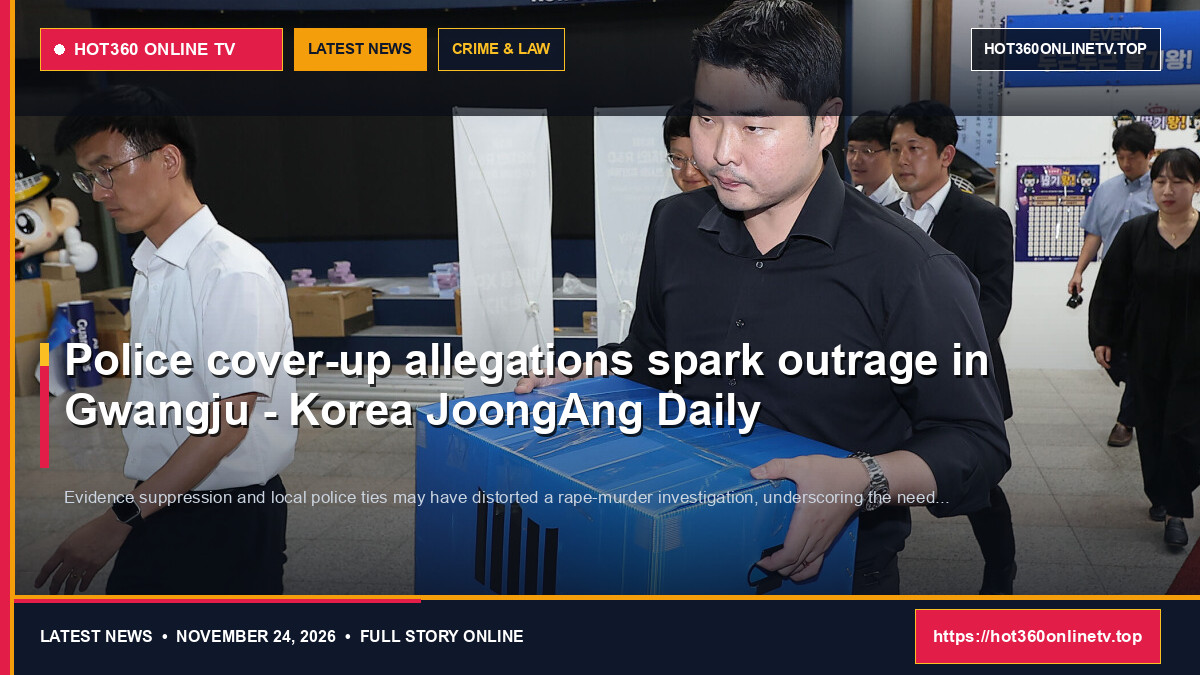
Evidence suppression and local police ties may have distorted a rape-murder investigation, underscoring the need for sweeping police reforms.
The author is a professor of police administration at Konkuk University and president of the Energy Security and Environment Association.
At the center of a small studio apartment stood an adult-sized female doll with its neck and chest grotesquely mutilated. The room belonged to 23-year-old Jang Yun-gi, who is accused of illegally filming middle school girls, stalking and confining a foreign woman and ultimately killing a 17-year-old high school student during an attempted sexual assault. Investigators found a space where sadistic fantasies and meticulous criminal planning appeared to intersect.
Yet facts emerging after the crime may prove almost as disturbing as the killing itself. Evidence has surfaced suggesting that investigators at the Gwangju Gwangsan Police Station attempted to destroy key evidence and downplay the case, despite indications that the murder was sexually motivated.
At the center of the controversy is suspicion that police sought to reduce the charge from murder committed for the purpose of rape, which carries a mandatory minimum sentence of life imprisonment, to ordinary murder, punishable by at least five years in prison. The allegation is particularly explosive because the suspect is the son of a police superintendent.
According to reports, investigators discovered cable ties and the damaged doll at the crime scene but failed to seize them. The head of the investigative team is also accused of ordering subordinates not to frame the case as a sex crime, going as far as ordering that evidence-gathering footage be deleted.
The team leader has since been arrested on charges including concealing evidence, abusing official authority and dereliction of duty. The police chief of the station has been booked, while the head of the criminal division remains under investigation after a court rejected a request for his arrest.
Related Article
• Police cannot investigate allegations against themselves
Police cannot investigate allegations against themselves
• Police investigation office raided over suspected evidence tampering in Gwangju murder case
Police investigation office raided over suspected evidence tampering in Gwangju murder case
• Acting head of police vows sweeping reforms after Jang Yun-gi case
Acting head of police vows sweeping reforms after Jang Yun-gi case
• Prosecutorial reform must not become a war of revenge
Prosecutorial reform must not become a war of revenge
As time passes, however, allegations surrounding Gwangsan Police Station appear to extend beyond the simple protection of a colleague’s family member. Questions are growing over whether institutional self-preservation and bureaucratic caution distorted the investigation itself.
Media reports cite multiple officers involved in the case as saying that Gwangsan Police Station reported developments to the National Office of Investigation and determined its course of action according to instructions from above. Senior officers at the station initially favored applying the charge of murder with intent to commit rape, but later changed their position after being advised to proceed carefully because of the lack of direct evidence such as a confession.
Officers have also testified that the decision to separately investigate Jang’s alleged rape and stalking of a Vietnamese woman, committed two days before the killing, was made under the direction of the National Office of Investigation. Search warrants executed against the agency on Tuesday reportedly mention concerns that combining the two cases would magnify the controversy.
The timing is significant. The crime occurred in May, shortly after police faced severe criticism and large-scale disciplinary measures over their inadequate response to the fatal stalking of a woman in Namyangju, Gyeonggi. At the time, the president publicly rebuked the police, and the organization as a whole was under intense scrutiny.
According to accounts from within the force, concerns about further criticism led police leaders to avoid cases involving stalking or sexual violence. Although new guidelines requiring the immediate booking of stalking suspects had been introduced, Jang was not formally booked despite the Vietnamese woman’s complaint.
Had investigators merged the homicide case with the stalking and sexual assault allegations, questions would inevitably have arisen about whether police had failed to follow their own directives.
Authorities must determine whether institutional self-protection and career-minded leadership deliberately concealed evidence supporting the allegation that Jang killed with the intent to rape and intentionally reduced the case to one of ordinary murder.
The scandal illustrates how criminal justice can collapse when a hyangchal cartel — networks of officers who spend decades working in the same region and develop close personal ties — combines with a culture of bureaucratic self-preservation among senior officials.
Jang’s father served at Gwangsan Police Station for 18 years, while the head investigator reportedly worked in the jurisdiction for about three decades. In such a closed personnel structure, local networks can influence the direction of investigations, protect insiders and contaminate the chain of command.
According to the Korean National Police Agency, only 6.5 percent of superintendents and 3.2 percent of lieutenants were transferred to other provinces over the past decade. When organizational circulation stalls, entrenched interests harden and investigative impartiality suffers.
Mandatory interregional rotations for senior officers in departments vulnerable to collusion should therefore be considered. Expanding official housing, subsidizing transportation costs and awarding promotion incentives to transferred officers could encourage mobility and reduce the risks of local favoritism.
The interior minister and the acting commissioner general of the National Police Agency have belatedly apologized and announced measures including the creation of an internal corruption unit under the National Office of Investigation. But because the agency itself now stands at the center of the controversy, piecemeal reforms alone will not restore public trust.
Comprehensive personnel changes reaching beyond frontline investigators to the senior command structure, including the National Office of Investigation, may be the most direct path toward rebuilding confidence in the fairness of police investigations.