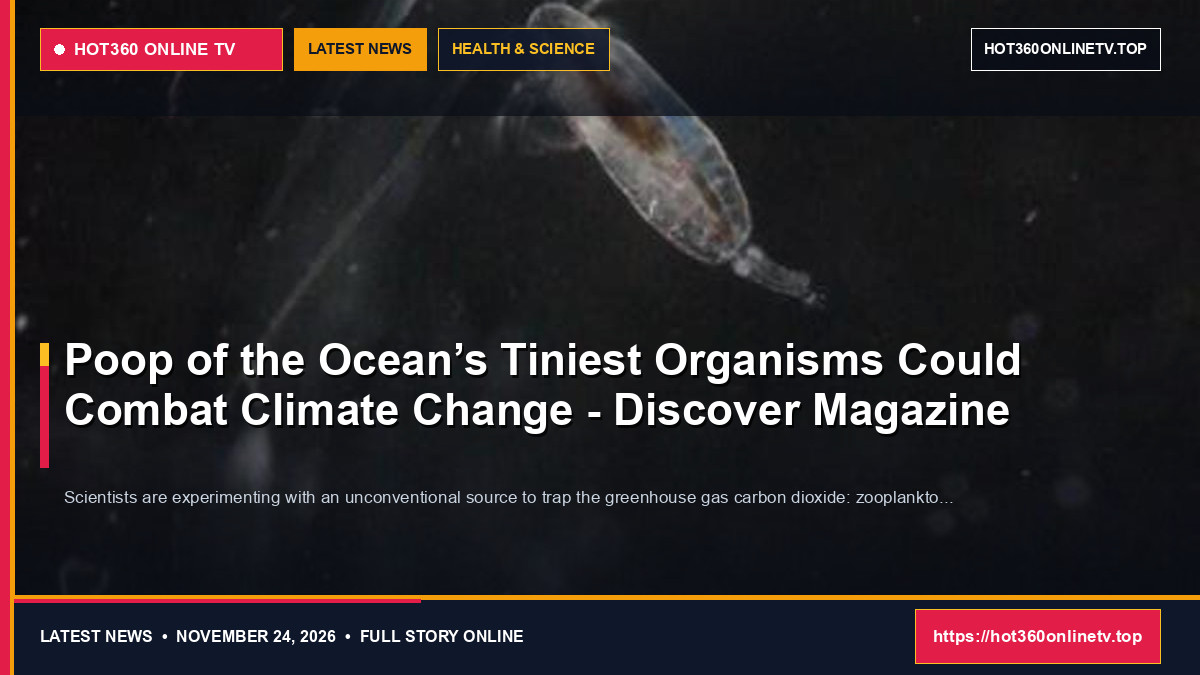
Scientists are experimenting with an unconventional source to trap the greenhouse gas carbon dioxide: zooplankton poop.
Earth needs more carbon sinks. As the planet warms, many of the places that trap CO2 are now releasing it into the atmosphere, rather than holding onto it. Trees are burning, permafrost is melting, and parts of the ocean are acidifying.
Those factors, combined with emissions remaining stubbornly high, despite many non-binding agreements to reduce them, prompted Mukul Sharma, a Dartmouth University geoscientist, to look for alternatives. He and colleagues propose a novel approach that involves zooplankton poop in a Nature report.
In Search of Carbon Sinks
Many groups are proposing carbon extraction exercises as well. But many approaches — like building machines to suck CO2 out of the atmosphere, then trap it — have several flaws, he says. They are expensive, often require energy, and seem difficult to scale up.
Large patches of phytoplankton — which, like algae, can bloom — already perform half of the carbon capture process. These blooms suck about 150 billion tons of carbon dioxide from the atmosphere. However, once the phytoplankton die, marine bacteria chomp on them, eventually releasing the CO2.
Read More: 5 of the Most Outlandish Ideas to Fight Climate Change
You have 1 more free article (1 of 2)
Subscribe today for full access and support our journalism.
Harnessing Zooplankton
How could that carbon instead stay put? Sharma was inspired by a study that came out of World War II, where the military tried to use sonar to locate German U-Boats.
The authors were perplexed that the bottom of the ocean appeared to change depths at various times of the day. Tiny creatures called zooplankton would rise and fall. Their population could become so dense that the sonar interpreters mistakenly read these groups as the ocean floor.
Could those creatures be harnessed into part of a biological carbon capture scheme? The challenge was finding a way to get zooplankton to chomp on the carbon before it was released — first into the ocean, then ultimately back into the atmosphere.
Feeding Zooplankton Dirt
Sharma’s geochemical background informed him of a possible solution, involving one of the most common geological resources: clay dust.
“The amount of dust in the atmosphere between [40,000 years to 20,000 years] ago may have actually helped take CO2 out of the atmosphere,” Sharma says.
As an experiment, Sharma’s team collected water from the Gulf of Maine during a 2023 phytoplankton bloom. First, they sprayed the surface of the bloom with clay dust. That dust grabs the organic carbon the phytoplankton released, forming sticky balls called flocs.
Fortunately, zooplankton don’t appear to be bothered about partially eating dirt; they seem to find the flocs delicious. They eat them, then excrete them, essentially trapping CO2 in their poop, which, along with the uneaten flocs, slowly falls to the floor.
Read More: Debunking 3 Common Climate Change Myths
Clay Is Key
The team's experiments demonstrated that clay dust captured as much as 50 percent of the carbon released by dead phytoplankton. The clay also increased the concentration of sticky organic by 10 times what just bacteria and phytoplankton would produce alone.
“The clay is super important,” says Sharma. And, "it's dirt cheap."
The next step is identifying a patch of ocean to expand the experiment. That patch must host phytoplankton blooms — and also be available for research by governing bodies. Once they secure permission, they’ll hire crop dusters to spray clay above the bloom. If the approach works, Sharma says it’s relative low cost could make it scalable.
Article Sources
Our writers at Discovermagazine.com use peer-reviewed studies and high-quality sources for our articles, and our editors review for scientific accuracy and editorial standards. Review the sources used below for this article:
• Nature. Organoclay flocculation as a pathway to export carbon from the sea surface
Nature. Organoclay flocculation as a pathway to export carbon from the sea surface