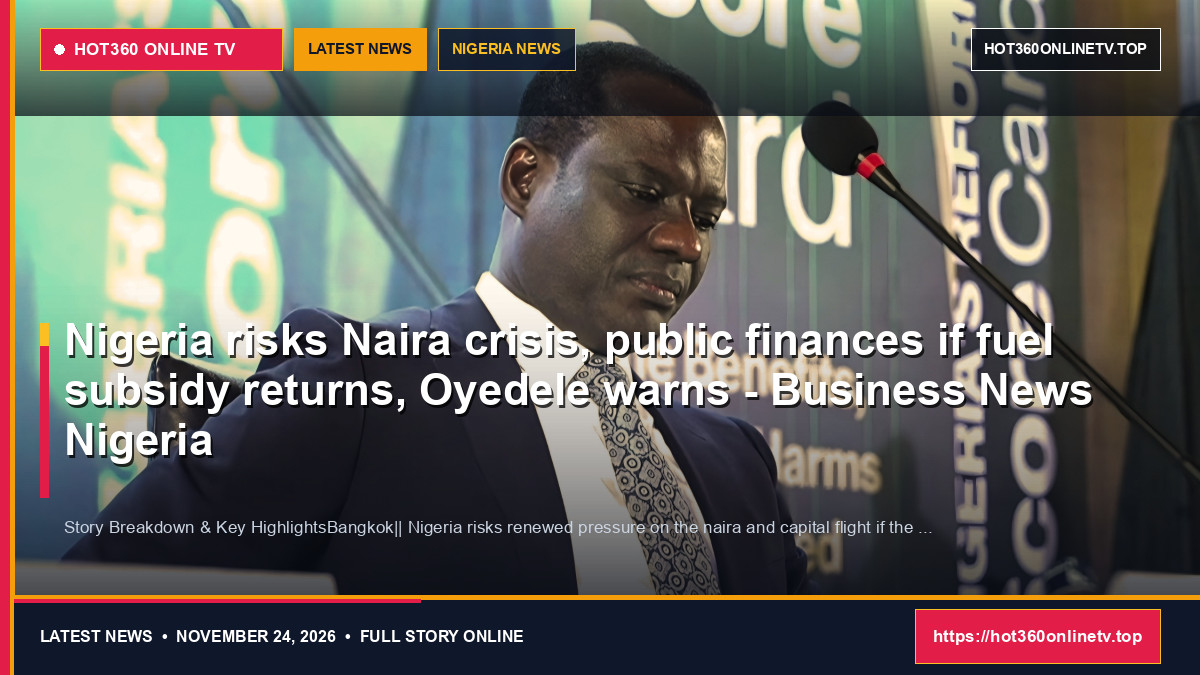
Story Breakdown & Key Highlights
- Bangkok|| Nigeria risks renewed pressure on the naira and capital flight if the government reverses its economic reforms to restore fuel subsidies, Taiwo Oyedele, finance minister...
- Oyedele, speaking at a press briefing to conclude the IMF-World Bank Annual Meetings in Bangkok, Thailand, said reversing the reforms could undermine investor confidence, trigger...
Full Report
Bangkok|| Nigeria risks renewed pressure on the naira and capital flight if the government reverses its economic reforms to restore fuel subsidies, Taiwo Oyedele, finance minister and coordinating minister of the economy, warned, defending fuel price discounts offered by the Nigerian National Petroleum Company (NNPC) as a commercial strategy rather than a government-funded subsidy.
Oyedele, speaking at a press briefing to conclude the IMF-World Bank Annual Meetings in Bangkok, Thailand, said reversing the reforms could undermine investor confidence, trigger capital outflows and reverse gains made in stabilising the foreign exchange market. He warned that even the suggestion that the government was considering a return to fuel subsidies could unsettle investors, prompt Nigerians to move their savings into foreign currencies and put additional pressure on the naira.
“Even Nigerians, the elites, the middle class, the high net worth, will move away from Naira. They will start buying dollars,” he said.
Oyedele added that capital outflows, combined with rising domestic demand for foreign currencies, could create a damaging cycle of instability in the foreign exchange market.
“They start moving against Naira. So capital is exiting. Nigerians are moving against the Naira. This is the perfect combination for the storm, for the devastating impact,” he said.
The minister also rejected suggestions that fuel price discounts offered through NNPC Retail amounted to a return to subsidies, arguing that the arrangement reflected normal commercial practices in which businesses reduce their profit margins to attract customers and increase sales.
“I do not know which part of the world you live in. It’s called retail marketing,” he said, explaining that businesses routinely offer discounts to boost sales and build customer loyalty.
“When they say buy one, get one free, that’s commercial. If they say take 10 percent off, that’s commercial,” he added. According to Oyedele, NNPC retail could increase sales volumes by offering more competitive prices, potentially recovering some of the reduced margins through higher sales over time. His comments come as the Federal Government seeks to defend its economic reforms amid persistent pressure over the cost of living and questions about whether the policies will be sustained ahead of the 2027 general elections.
The removal of petrol subsidies in 2023 and the liberalisation of the foreign exchange market have formed key pillars of the government’s reform programme, which officials say is intended to improve fiscal sustainability, strengthen market confidence and establish a more stable macroeconomic environment.
However, the reforms have also increased pressure on households and businesses through higher fuel and transportation costs, fuelling calls for additional government intervention to cushion the impact.
Oyedele said concerns about a possible reversal of the reforms had featured repeatedly in his engagements with investors during the annual meetings, with international investors seeking assurances that Nigeria would maintain its policy direction.
He argued that restoring fuel subsidies could jeopardise the progress made in stabilising the economy, particularly if investors interpreted such a move as a retreat from the government’s commitment to fiscal discipline and market-based pricing.
A renewed loss of confidence, he warned, could encourage investors to withdraw capital while prompting domestic savers to seek protection against possible naira depreciation by buying dollars, increasing pressure on the foreign exchange market.
Conversely, he said sustained reforms could help lower inflation, reduce borrowing costs and support stronger economic growth by creating a more predictable environment for investment and business expansion.
The government is targeting economic growth of 7 per cent, while Oyedele has argued that bringing inflation down to low single digits would help create the conditions for single-digit interest rates. Lower inflation and borrowing costs, he said, would improve access to credit for businesses, encourage investment and support faster expansion across productive sectors of the economy.
For the administration, the challenge is to maintain investor confidence and preserve the gains from its reforms while convincing Nigerians that the longer-term benefits of economic stability and growth will outweigh the immediate costs of adjustment.
• Over 60 killed following murder of village head in Niger
• Festive airfare hits N800,000 as operators reopen dormant routes
• APC’s 40,000mw promise remains a distant dream after 11 years
Hope Moses-Ashike is an Associate Editor, Banking and Finance, with more than a decade of experience reporting on Nigeria’s financial…