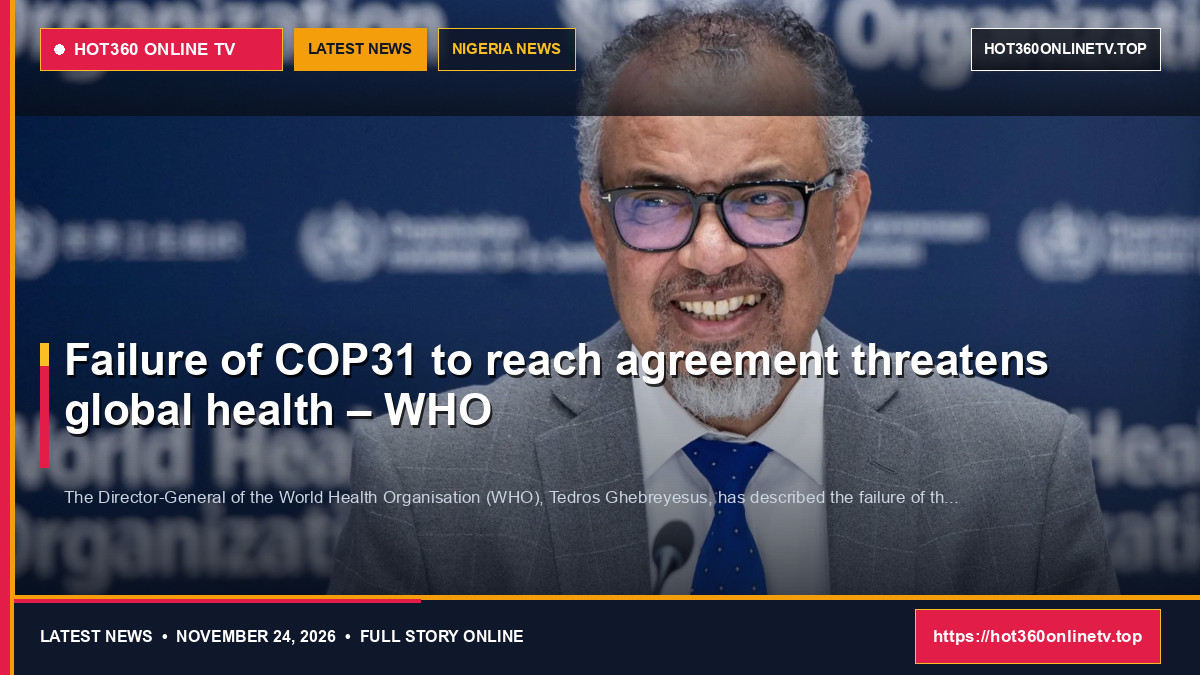
The Director-General of the World Health Organisation (WHO), Tedros Ghebreyesus, has described the failure of the 31st United Nations Climate Change Conference (COP31) to reach an agreement as a grave setback for global health.
Join the Premium Times WhatsApp Community For Quick Access To News and Happenings Around You.
Mr Ghebreyesus said the failure to agree on measures to protect lives and health would leave vulnerable communities exposed to the growing health impacts of climate change.
In a post on X on Tuesday, the WHO chief said the outcome also represents a missed opportunity to scale up proven interventions that could save more than 1.5 million lives annually.
“The failure of COP31 to deliver an agreement that protects people’s lives and health is a grave setback,” he wrote.
He also criticised the inability of countries to agree on how to advance the transition away from fossil fuels, noting that it is “another missed opportunity to save millions of lives from air pollution.”
“We urged leaders to negotiate as though lives depended on it. Because they do,” he said.
Mr Ghebreyesus said the WHO would continue working with scientists, health professionals and civil society organisations to push for climate action that protects people’s health.
Stay Ahead with Premium Times
Follow us on Google News and never miss breaking stories, investigations, and in-depth reporting.
Air pollution remains a major global health threat. The State of Global Air 2025 report estimated that air pollution caused 7.9 million deaths worldwide in 2023, accounting for about 13 per cent of all deaths globally.
Disagreement over fossil fuels stalled negotiations
COP31 ended in Antalya, Turkiye, on Sunday without consensus on the proposed overarching agreement, after more than two weeks of negotiations that ran nearly 48 hours past the scheduled closing date.
The failure followed deep disagreements among participating countries over the transition away from fossil fuels, climate finance and other contentious issues.
PREMIUM TIMES reported that an initial draft agreement released by the COP31 presidency on 16 November proposed increasing annual climate adaptation finance for developing countries to at least $120 billion by 2035 and called for accelerated action to phase out fossil fuels.
However, a revised draft released later in the negotiations removed the direct reference to transitioning away from fossil fuels and the proposed adaptation finance target.
In its report on the revised draft, PREMIUM TIMES found that the document had been reduced from 18 pages and 144 paragraphs to nine pages and 80 paragraphs.
Countries remained divided over the proposed agreement, with the European Union, Norway, Canada and the United Kingdom among those that rejected the final text.
The COP31 president, Murat Kurum, subsequently confirmed at the closing plenary that the proposed Antalya Pact would not be approved.
PREMIUM TIMES also reported that representatives of Ghana, speaking on behalf of the African bloc, expressed dissatisfaction with the negotiation process, while no Nigerian representative addressed the closing plenary.
Health impacts of climate change
The WHO has repeatedly warned that climate change poses serious risks to human health, including through extreme heat, air pollution, food insecurity and the spread of climate-sensitive infectious diseases.
At the opening of COP31, global health and climate funders announced more than $375 million in funding to address climate-related health challenges.
READ ALSO: COP31: African climate coalition says no deal better than ’empty’ text, sets demands for COP32
The funding was expected to support measures addressing extreme heat, air pollution, climate-sensitive infectious diseases, and other health risks associated with global warming.
In Nigeria and several other countries worldwide, surging temperatures have fuelled public health concerns in recent years.
Speaking at the opening ceremony, Simon Stiell, executive secretary of UN Climate Change, said the world is witnessing dangerous heat levels that expose hundreds of millions of people to extreme temperatures.
“As today’s important data from the WMO shows, the world is getting dangerously hot. Hundreds of millions of people are exposed to extreme heat across Southern Asia,” Mr Stiell said.
Discover more from Premium Times Nigeria
Subscribe to get the latest posts sent to your email.