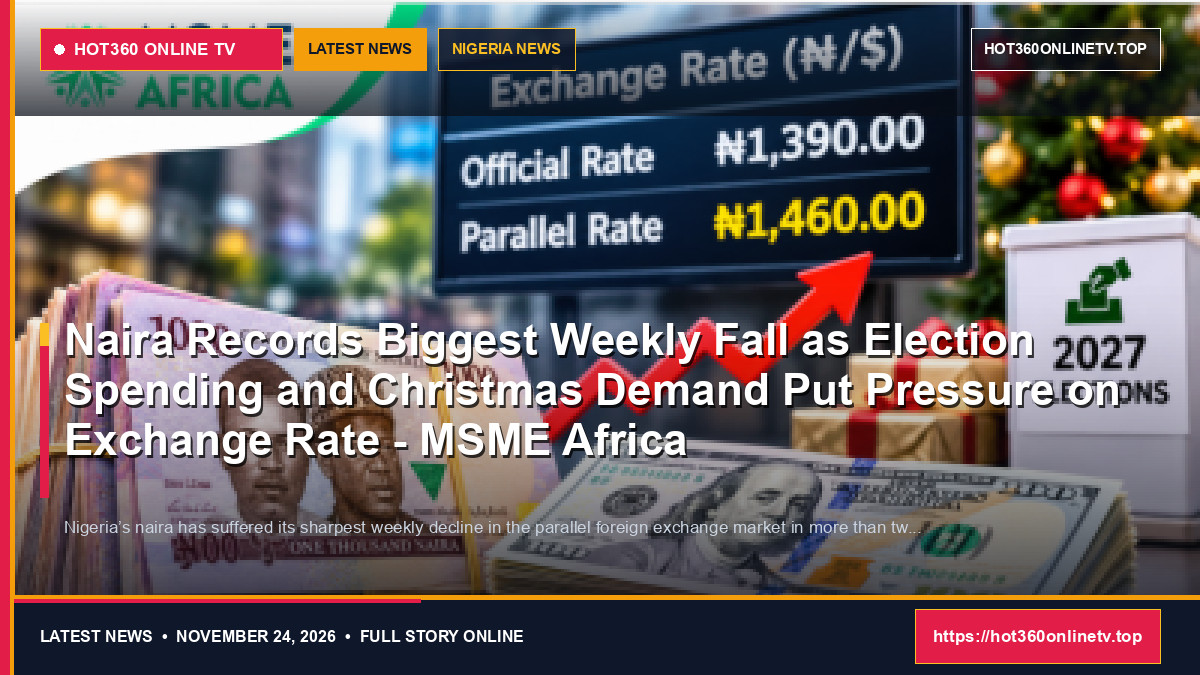
Nigeria’s naira has suffered its sharpest weekly decline in the parallel foreign exchange market in more than two years, as rising demand for dollars ahead of the Christmas season and increasing political activity ahead of the 2027 general elections put renewed pressure on the local currency.
The depreciation is raising fresh concerns for businesses, importers, traders and households already dealing with high operating costs and expensive imported goods.
Recent market data show that the pressure has been more pronounced in the parallel market, although the official foreign exchange market has also recorded further weakness.
Naira loses ground against the dollar
According to a report by BusinessDay published on November 20, the parallel-market exchange rate weakened from approximately ₦1,360 per dollar on October 3 to ₦1,460 on November 18.
That represents a depreciation of ₦100, or about 7.35 per cent, over the period.
The decline was particularly sharp between November 11 and November 18. Verto, an international payments and foreign exchange company, reported that the parallel-market rate moved from approximately ₦1,385 to ₦1,475 per dollar over five trading sessions, representing a 6.5 per cent fall in the naira.
The official Nigerian Foreign Exchange Market (NFEM) also weakened, although at a slower pace. BusinessDay reported that the official rate moved from ₦1,330.09 on October 2 to ₦1,363.23 on November 18.
The difference between the official and parallel-market rates consequently widened, reflecting stronger demand for dollars in the informal market and uneven access to foreign currency.
Why is the naira coming under pressure?
Analysts and market participants have identified a combination of seasonal demand, election-related transactions and reduced foreign exchange inflows as factors contributing to the recent depreciation.
1. Christmas and end-of-year dollar demand
Demand for foreign currency traditionally increases towards the end of the year.
Nigerians travelling abroad for holidays, businesses importing goods for the festive season, parents paying international school fees and individuals settling overseas medical bills all contribute to increased demand for dollars.
Importers also need foreign currency to replenish stock ahead of the Christmas and New Year trading period.
When demand rises faster than the supply of dollars available in the market, the exchange rate can come under pressure.
2. Political activities ahead of the 2027 elections
Nigeria is also moving towards the January 16, 2027 general elections, with political positioning and election-related activities adding another potential source of foreign exchange demand.
Market participants have identified demand associated with imported election equipment, logistics and politically linked transactions as additional pressure points.
Analysts have also warned that increased election-related government spending could inject more naira liquidity into the economy, potentially increasing demand for foreign currency.
However, election spending is one of several factors being cited; it should not be treated as the sole explanation for the naira’s decline.
3. Lower foreign exchange inflows
The pressure is also occurring at a time when foreign currency inflows into Nigeria’s market have weakened.
Data from Coronation Merchant Bank cited by BusinessDay showed that total foreign exchange inflows fell by 67 per cent week-on-week to $807.6 million, from $2.48 billion in the preceding week.
The reduction in available inflows makes it more difficult for the market to meet increased demand for foreign currency.
4. Declining external reserves
Nigeria’s external reserves have also come under pressure.
The reserves declined to approximately $54.65 billion as of November 19, 2026, according to figures reported on November 21. This was down from a recent peak of about $55.26 billion recorded in October.
Although reserves remain higher than their level during the corresponding period of 2025, the recent decline is being watched closely by investors and currency-market participants.
What does this mean for Nigerian businesses?
The weakening naira could have practical consequences for businesses, particularly those that depend on imported raw materials, machinery, equipment, packaging materials and finished products.
For import-dependent businesses, a higher dollar exchange rate means more naira is required to purchase the same quantity of foreign goods.
This can increase inventory costs, reduce profit margins and force businesses to review their selling prices.
Small businesses may be particularly exposed because they often have limited working capital and less bargaining power with suppliers.
For example, a business that previously needed ₦13.6 million to purchase goods worth $10,000 at an exchange rate of ₦1,360 per dollar would need ₦14.6 million if the exchange rate moved to ₦1,460 per dollar.
That is an additional ₦1 million for the same dollar-denominated purchase, before considering shipping, duties and other charges.
Businesses that depend on imported inputs may therefore face difficult decisions: absorb the additional costs, increase prices or reduce the quantity of goods they purchase.
Will the naira continue to depreciate?
The outlook remains uncertain.
Coronation Asset Management has warned that Nigeria could experience periodic exchange-rate volatility through 2027, pointing to tight market liquidity, uneven foreign exchange inflows and changing investor behaviour.
Its baseline outlook places the naira within a range of ₦1,400 to ₦1,550 per dollar in 2027, while a more negative scenario sees the currency weakening further if election spending accelerates, oil receipts decline and foreign portfolio investors withdraw funds.
These are projections, not guaranteed outcomes.
Nigeria’s external reserves, oil receipts, foreign investment inflows, monetary policy decisions and the Central Bank of Nigeria’s foreign exchange management will all influence how the currency performs in the coming months.
What should business owners do?
For Nigerian entrepreneurs and business owners, the latest depreciation is a reminder to pay closer attention to foreign exchange exposure and cash-flow management.
Some practical steps include:
• Review pricing regularly: Businesses that depend on imported products or materials should review their cost assumptions rather than rely on outdated exchange rates.
• Avoid unnecessary stockpiling: Buying more inventory than the business can comfortably finance may create cash-flow problems, especially if exchange rates or prices change.
• Explore local alternatives: Where quality and availability permit, sourcing locally can reduce exposure to foreign exchange movements.
• Negotiate with suppliers: Businesses can explore better payment terms, bulk-purchase arrangements and more predictable supply agreements.
• Protect working capital: Avoid committing all available cash to inventory purchases. Maintain sufficient funds for salaries, logistics, rent and other operating expenses.
• Monitor legitimate foreign exchange channels: Businesses should understand the documentation and requirements for accessing foreign currency through authorised channels.
What Nigerians should watch in the coming weeks
The direction of the naira will depend partly on whether foreign exchange inflows improve and whether the increase in seasonal and election-related demand can be matched by adequate dollar supply.
The Central Bank of Nigeria’s next policy decisions, movements in external reserves, oil receipts and investor confidence will also be important indicators.
For now, the latest depreciation is a reminder that exchange-rate movements are not just figures on a financial-market screen. They affect the cost of importing goods, running businesses, restocking shops and, ultimately, the prices consumers pay.
As Christmas approaches and political activities ahead of the 2027 elections gather momentum, Nigerian businesses and households will be watching the foreign exchange market closely.
MSME Africa will continue to track developments in the naira, inflation, interest rates and other economic issues affecting Nigerian businesses and households.
Related Posts:
• Nigeria Could Spend 72% of Government Revenue on…
• MSME Africa Unveils Top 50 Remarkable MSME Founders…
• Ultimate 2026 Guide to the Top Business Enabling…
• Overcoming Binding Constraints to Competitive…
• Petrol Prices in Nigeria: FCCPC Warns Marketers as…
• Petrol Prices Drop Again in Nigeria: New NNPC, MRS…
WhatsApp Security Flaw Raises Fraud Concerns for Nigerian Businesses
Nigeria to Begin Local Production of International Passports in May 2027
• High Costs and Naira Depreciation Dampening Optimism in Services and Trade Sectors
High Costs and Naira Depreciation Dampening Optimism in Services and Trade Sectors
• Nigeria’s Foreign Exchange Turnover Increases by 33.8% as Naira Depreciates
Nigeria’s Foreign Exchange Turnover Increases by 33.8% as Naira Depreciates
Leave a Reply Cancel reply
Young Nigerians seeking to build careers in technology, entrepreneurship and other emerging fields can now apply for free digital skills training through the IAVE RRA SkillsBuild Programme, Cohort 10, facilitated by Young Advocates for a Sustainable and Inclusive Future (YASIF Nigeria) in collaboration with the International Association for Volunteer Effort (IAVE) and IBM SkillsBuild.
The programme provides participants with fully funded access to self-paced online courses designed to develop practical skills, improve employability and prepare young people for opportunities in the changing world of work.
The available learning tracks cover 12 areas, including Artificial Intelligence (AI), cybersecurity, data science and data management, entrepreneurship and startups, digital and social media marketing, communication and public speaking, leadership and empowerment, career development and employability, financial literacy and management, project planning and management, creative thinking and innovation, and climate change and sustainability.
Through the programme, participants can access flexible learning opportunities that allow them to study at their own pace while developing skills relevant to their career interests and professional goals.
What Participants Will Receive
Successful participants will have access to several learning and career development benefits, including:
• Free digital skills training: Fully funded access to the programme’s available learning tracks without tuition fees.
• IBM-recognised certificates: Participants who successfully complete eligible courses can earn digital credentials recognising the skills acquired.
• Self-paced learning: Participants can complete their courses at a flexible pace, making it possible to combine training with school, work and other commitments.
• Career mentorship: Opportunities to receive guidance to support professional development and career progression.
• Job opportunities: Access to potential employment opportunities as part of the programme’s career development support.
The programme is designed for young people interested in acquiring practical digital, business and professional skills.
It may be particularly relevant to:
• Students seeking additional skills to complement their academic qualifications.
• Graduates looking to improve their employability.
• Unemployed and underemployed young people seeking career opportunities.
• Early-career professionals interested in developing new competencies.
• Aspiring entrepreneurs looking to strengthen their business and digital skills.
The current Cohort 10 announcement does not specify a particular age limit, academic qualification or application deadline. Interested applicants should consult the application portal for the latest requirements.
Interested Nigerians can apply for Cohort 10 by completing the online application form.
Application link: https://bit.ly/44TW6jC
Applicants can also visit the organisation’s website at https://www.yasif.org for additional programme information.
The Federal Government will make 40 semi-annual principal repayments of 2.5 per cent each, equivalent to $12.5 million per instalment if the entire credit facility is drawn.
According to the financing agreement obtained from the World Bank’s website, the first repayment is due on May 15, 2031, while the final instalment is scheduled for November 15, 2050.
The repayment arrangement means Nigeria will continue servicing the agricultural credit for more than 18 years after the project is expected to close on July 30, 2032.
The $500 million financing was approved by the World Bank in March 2026 to support the Nigeria Sustainable Agricultural Value-Chains for Growth project, also known as AGROW.
The programme is designed to improve smallholder farmers’ productivity, strengthen agricultural value chains, expand market access and create jobs across participating states.
The financing agreement was signed by the Minister of Finance, Taiwo Oyedele, on October 29, 2026, while the World Bank Country Director, Mathew Verghis, signed on September 16, 2026.
How the $500m Agricultural Credit Will Be Used
Under the agreement, $230 million, representing 46 per cent of the total financing, is allocated to performance-based matching grants for agribusiness investments.
The grants will support businesses involved in agricultural aggregation, storage, processing, logistics, post-harvest handling and market connections between farmers and buyers.
Another $229.5 million, representing 45.9 per cent, will finance goods, infrastructure works, consultancy services, operational expenses and training.
The remaining $40.5 million is reserved for expenditure linked to performance-based conditions under the programme.
The project will also support agricultural research, improved seed varieties, extension services, digital farmer registration and artificial intelligence-powered weather forecasting.
Additional interventions will focus on strengthening seed certification, improving fertiliser quality regulation and promoting responsible agricultural land investments.
States Must Meet Conditions to Access Funding
The financing agreement requires participating states to fulfil specific conditions before they can access funds under the programme.
According to the agreement, states must adopt responsible land investment frameworks and establish regulations supporting a common digital farmer registry.
They are also required to publish consolidated schedules of fees and levies imposed on the movement of goods between states, alongside reports detailing traders’ complaints and remedial actions.
Participating states must equally publish policies linking support for agricultural cooperatives to verified commercial relationships with buyers.
The agreement provides that funds cannot be released to participating states until the Federal Government presents satisfactory evidence of compliance and executes the required subsidiary agreements.
The World Bank may also withhold, reallocate or cancel financing linked to performance targets that are not achieved.
Among the targets is the registration of farmers in a national digital registry, with basic and enhanced coverage targets of 40 per cent and 70 per cent, respectively.
The agreement also requires the Federal Government to establish a national steering committee and project coordination unit within three months of the project becoming effective.
What This Means for Nigerian Agribusinesses
The AGROW programme is expected to provide financing opportunities for agribusinesses involved in agricultural production, processing, storage, logistics and commodity aggregation.
The $230 million matching grant component is particularly relevant to businesses investing in facilities and services that connect smallholder farmers to markets.
Small businesses operating in rice, maize, cassava and soybean value chains could also benefit from improved agricultural inputs, research, extension services and stronger market linkages.
However, access to the matching grants and other project support will depend on the programme’s eligibility requirements and the compliance conditions applicable to participating states.
Tags: World Bank, agricultural financing, Nigerian SMEs, AGROW project, smallholder farmers, agribusiness, agricultural loans, food security, Nigeria
A new development has emerged from the partnership between the Small and Medium Enterprises Development Agency of Nigeria (SMEDAN) and global payments company Mastercard, with an initial target of reaching 100,000 Nigerian businesses through digitalization and business support initiatives.
The partnership is expected to help micro, small and medium-sized enterprises (MSMEs), particularly rural businesses and farmers, adopt digital payment solutions, improve business records, develop digital skills and connect with financial institutions and wider markets.
The development was reported by Punch on November 23, 2026, following the signing of a Memorandum of Understanding (MoU) between SMEDAN and Mastercard at the MSME Growth Forum in Lagos.
For Nigerian business owners who struggle with access to finance, poor business records, limited digital capabilities and difficulty reaching customers, the initiative could create new opportunities.
However, there is an important clarification: the partnership is not an announced cash grant or loan programme, and no dedicated application portal or beneficiary registration deadline has been published.
Here is what Nigerian entrepreneurs should know and how they can prepare.
What is the SMEDAN–Mastercard partnership about?
The partnership is designed to explore ways of helping Nigerian MSMEs participate more effectively in the digital economy.
Under the MoU, SMEDAN and Mastercard will explore initiatives that can help small businesses:
* Adopt digital payment solutions. * Improve business operations and record-keeping. * Develop digital and business management skills. * Connect with financial institutions. * Improve access to customers and markets. * Strengthen their ability to participate in the formal economy.
The agreement builds on the Federal Ministry of Industry, Trade and Investment’s support for the design and piloting of a national MSME Digitisation Programme.
The two organisations intend to combine Mastercard’s technology and expertise with SMEDAN’s nationwide reach to help businesses overcome some of the barriers limiting their growth.
What does the 100,000-business target mean?
According to Punch, the partnership has an initial target of reaching 100,000 enterprises, with particular attention to rural businesses and farmers.
This is significant because many Nigerian small businesses operate with limited access to digital payment infrastructure, formal financial services and business development support.
For example, a small retailer who receives all payments in cash may struggle to build a reliable transaction history that can demonstrate business performance to a lender.
A farmer who relies entirely on traditional trading networks may also find it difficult to reach larger buyers or access digital marketplaces.
By encouraging digital payments and improved business records, the partnership could help businesses become more visible to financial institutions, suppliers and potential customers.
However, the 100,000 figure is a target reported by Punch. The official Mastercard MoU announcement describes the collaboration and its objectives but does not publish a detailed beneficiary selection or enrolment plan.
Which Nigerian businesses could benefit?
The partnership is intended to support MSMEs across Nigeria, with particular attention to rural enterprises and agricultural businesses.
Potential areas of relevance include:
Small shops, market traders, distributors and other retail businesses could benefit from improved digital payment capabilities and better transaction records.
Digital payment acceptance can make it easier to receive payments, track sales and manage daily business transactions.
2. Farmers and agribusinesses
Smallholder farmers, agricultural processors, aggregators and rural enterprises are among the groups specifically highlighted in reports about the partnership.
Digital tools could help these businesses improve payment collection, access information, connect with buyers and strengthen their commercial records.
Small manufacturers could benefit from digital tools for sales management, payments, inventory control and business operations.
Better records can also help business owners understand their costs, monitor performance and make more informed decisions.
Restaurants, logistics operators, professional service providers, beauty businesses and other service-based MSMEs could benefit from digital payments, marketing tools and improved customer management.
5. Digital and creative businesses
Entrepreneurs operating online businesses, creative enterprises and technology-driven services could also find opportunities to improve their digital operations and reach more customers.
These are examples of businesses that could benefit from the partnership’s stated areas of focus. They are not a confirmed list of eligible beneficiary categories.
Will SMEDAN and Mastercard give businesses grants or loans?
This is probably the most important question for entrepreneurs.
The partnership announcement does not confirm a new cash grant, business loan or specific funding allocation.
Although access to finance is one of the issues the collaboration seeks to address, the announcement focuses on digital payments, business capabilities, market access and connections to financial institutions.
There is a difference between helping a business become better positioned to access credit and announcing a loan facility that businesses can apply for immediately.
For now, entrepreneurs should not interpret the 100,000-business target as 100,000 grants or loans.
SMEDAN and Mastercard have not published a dedicated funding amount, loan interest rate, grant value or application deadline for this partnership.
How can Nigerian businesses prepare to benefit?
Although a dedicated application process has not been announced, business owners can take practical steps to improve their readiness for future initiatives.
Step 1: Register your business with SMEDAN
SMEDAN encourages Nigerian MSMEs to register so the agency can build a more reliable database of businesses and better understand their needs.
Business owners can visit the official registration portal:
https://portal.smedan.gov.ng/signup
SMEDAN registration does not guarantee selection for the Mastercard partnership, but it can help the agency identify and understand your business.
Step 2: Improve your business records
Start keeping accurate records of sales, expenses, purchases, inventory and customer transactions.
Even a small business should be able to explain how much it earns, what it spends and whether it is making a profit.
These records can help with business planning and may be useful when dealing with financial institutions.
Step 3: Adopt digital payments
Consider accepting transfers, POS payments and other appropriate digital payment options.
Digital transaction records can make it easier to monitor business activity and demonstrate how your business performs.
Step 4: Build your digital skills
Learn how to use digital tools for marketing, customer management, accounting, inventory tracking and online sales.
Businesses do not necessarily need expensive software to start improving their digital operations. There are accessible tools that can help entrepreneurs manage their activities more efficiently.
Step 5: Monitor official SMEDAN announcements
Watch for further information about the partnership, including possible enrolment arrangements, training opportunities, digital tools and eligibility requirements.
Use SMEDAN’s official website as a starting point:
Do not submit sensitive personal or business information through unofficial links claiming to offer guaranteed access to the programme.
Why digitalization matters for Nigerian MSMEs
For many Nigerian entrepreneurs, the biggest business challenge is not necessarily a lack of customers or a poor product. It is the inability to manage and grow the business efficiently.
A trader may make daily sales but have no reliable record of revenue. A small manufacturer may struggle to monitor inventory. A farmer may produce quality goods but lack access to buyers beyond the local market.
Digitalisation can help address some of these challenges.
* Digital payments create transaction records. * Accounting software helps business owners monitor income and expenses. * Digital marketing allows small businesses to reach customers beyond their immediate locations. * Inventory systems help reduce stock losses and improve purchasing decisions. * Customer relationship tools help businesses manage enquiries and retain customers.
These capabilities can also improve a business’s ability to engage with banks, investors, suppliers and larger companies.
This is why the SMEDAN–Mastercard partnership is worth watching, even though it is not a direct funding announcement.
What has Mastercard said about the partnership?
Mastercard’s Executive Vice President for Growth Segments, Tara Nathan, said small businesses face barriers relating to digitalisation, skills development and access to finance.
She explained that the partnership would explore ways of providing entrepreneurs with the tools, capabilities and connections needed to participate more fully in the digital economy.
SMEDAN Director-General, Charles Odii, also emphasised that Nigerian entrepreneurs need practical tools, skills and support that reflect the realities of running small businesses.
He identified financing, infrastructure, electricity and skills shortages as some of the major challenges affecting MSMEs.
The partnership is therefore intended to address a broader range of business needs rather than focus exclusively on access to funding.
Is there a registration deadline?
As of the latest announcements reviewed for this report, SMEDAN and Mastercard have not published a dedicated application deadline or nationwide enrolment timetable for the partnership.
The 100,000-business target does not mean that applications are currently open or that beneficiaries have already been selected.
Entrepreneurs should wait for formal programme instructions before assuming that a particular website or registration form is the official application channel.
Final thoughts
The SMEDAN–Mastercard partnership could become an important intervention for Nigerian MSMEs if it translates into practical digital tools, skills development, market access and stronger connections to financial institutions.
The reported target of reaching 100,000 businesses is significant, particularly for rural enterprises and farmers who are often excluded from formal business support systems.
But the real value of the initiative will depend on how it is implemented, which businesses are reached and whether the promised support translates into measurable improvements in business productivity and growth.
For now, entrepreneurs should register with SMEDAN, improve their business records, explore digital payment options and monitor official announcements.
The opportunity to watch is not simply whether businesses will receive funding, but whether more Nigerian MSMEs will gain the digital capabilities and market connections they need to grow.
MSME Africa will continue to monitor the partnership and publish updates when SMEDAN and Mastercard announce specific implementation and participation arrangements.
• Business4 years ago BREAKING: CBN announces New Withdrawal Policies, Pegs ATM Withdrawals Limit at N20,000 daily, N100,000 weekly
BREAKING: CBN announces New Withdrawal Policies, Pegs ATM Withdrawals Limit at N20,000 daily, N100,000 weekly
• Business6 years ago First Bank Nigeria Joins SME Finance Forum
First Bank Nigeria Joins SME Finance Forum
• Business6 years ago FG Opens Application Portal for N75 Billion MSME Survival Fund 10pm Today, Releases Time-table for Payroll Support Scheme for different sectors
FG Opens Application Portal for N75 Billion MSME Survival Fund 10pm Today, Releases Time-table for Payroll Support Scheme for different sectors
• Business5 years ago Sendbox raises $1.8 million in seed funding to digitize deliveries for African SMEs
Sendbox raises $1.8 million in seed funding to digitize deliveries for African SMEs
• Business3 years ago Call for Applications: MTN ICT and Business Skills Training (N90 Million Grant for 300 Participants)
Call for Applications: MTN ICT and Business Skills Training (N90 Million Grant for 300 Participants)
• Business6 years ago How to apply and benefit from free CAC Business Name Registration for 250,000 MSMEs
How to apply and benefit from free CAC Business Name Registration for 250,000 MSMEs
• Business4 years ago Call for Applications: Rural Youth Skill Acquisition Programme for Nigerian Youths (receive N50,000 monthly stipend)
Call for Applications: Rural Youth Skill Acquisition Programme for Nigerian Youths (receive N50,000 monthly stipend)
• Articles & Resources6 years ago How to put your house in order for tax purposes
How to put your house in order for tax purposes