Story Breakdown & Key Highlights
- Vice President Professor Jane Naana Opoku-Agyemang has urged businesses in Ghana to embrace Artificial Intelligence (AI) and sustainable business practices to strengthen their...
- She said innovation had become essential to business survival and growth, warning that companies that fail to adapt to technological advancements risk losing their competitive...
Full Report
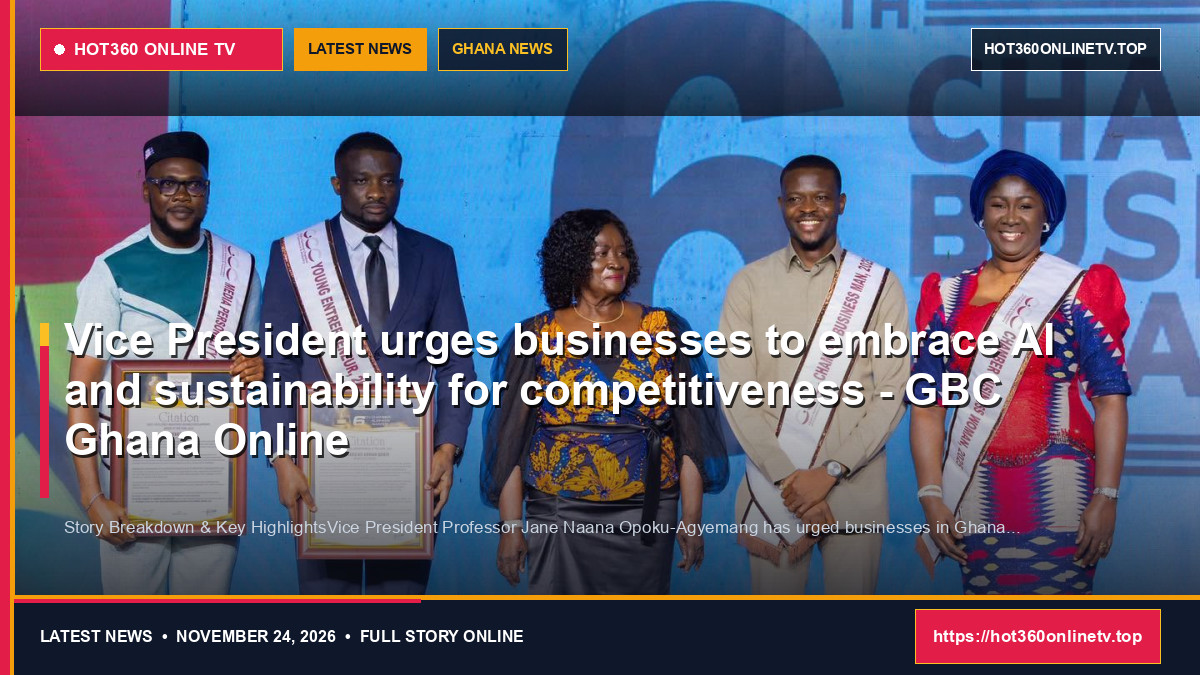
Vice President Professor Jane Naana Opoku-Agyemang has urged businesses in Ghana to embrace Artificial Intelligence (AI) and sustainable business practices to strengthen their competitiveness and build resilience in an increasingly challenging global business environment.
She said innovation had become essential to business survival and growth, warning that companies that fail to adapt to technological advancements risk losing their competitive advantage.
The Vice President made the call at the 6th Chamber Business Awards, held under the theme, “Shaping a Resilient Future: The Role of Sustainability and AI in Business.”
She noted that the rapid advancement of Artificial Intelligence had transformed the business landscape, creating new opportunities for companies to improve efficiency, productivity and decision-making.
She said “the government, under President John Dramani Mahama, recognised the private sector’s role in driving economic growth and was committed to creating an enabling environment for local businesses to expand and compete internationally”.
She cited government’s initiative to support local businesses to process more of Ghana’s products into semi-processed goods by 2030 as part of efforts to strengthen domestic industries and increase the country’s productive capacity.
The Vice President also identified the 24-Hour Economy policy as a major intervention expected to boost production and employment when fully operational.
The awards ceremony which is a flagship of the Ghana National Chamber of Commerce and Industry, a platform for recognising outstanding business performance, celebrate enterprise leadership and honour individuals and organisations whose achievements contribute to Ghana’s economic development.
Adding his voice, President of the Ghana National Chamber of Commerce and Industry, Nana Agyenim Boateng, said Ghana must now focus on translating its gains in macroeconomic stability into sustained economic growth, increased investment and productive employment.
He observed that although the country had made progress in restoring macroeconomic stability following a period of economic difficulty, businesses continued to face structural challenges that affected their operations and growth.
Mr Boateng identified the high cost of doing business, limited access to affordable long-term financing, energy costs, infrastructure deficits and regulatory challenges as some of the major constraints requiring urgent attention.
He said government’s New Economy: New Ghana, Jobs and Prosperity Programme for 2027 to 2030 presented an opportunity to address these challenges, stressing that the private sector must play an active role in its implementation through increased production, investment and job creation.
Mr Boateng further highlighted the opportunities presented by Ghana’s participation in the African Continental Free Trade Area (AfCFTA), noting that businesses must strengthen their capacity in manufacturing, agriculture, agro-processing, technology and skills development to expand into regional and international markets.
He stressed that Ghana must move beyond exporting raw materials and increase its capacity to produce, process and export more value-added goods to maximise the benefits of regional trade.
The 6th Chamber Business Awards also recognised businesses and individuals for their contributions to Ghana’s economic development.
Among the award recipients were Linda Ampa of KAD Manufacturing Limited, Nutrifoods Ghana, Petrosol Platinum Energy PLC and Melcom Group Limited, alongside several other businesses and industry players.